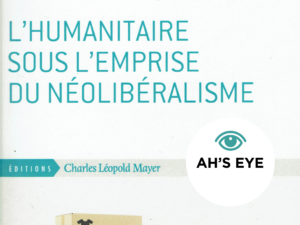
 In his third essay, Contre-histoire de l’humanitaire, Bertrand Bréqueville continues the critical reflection begun in L’Humanitaire sous l’emprise du néolibéralisme (2021) and L’Humanitaire à l’épreuve de l’impérialisme (2024 [all published in French]). Interviewed on 25 November at a presentation of his book at Médecins du Monde – France, he defends a radical thesis: institutionalised humanitarianism has become an ideology used to promote capitalism.
Boris Martin – In your latest book, to sum it up very briefly, you state that “institutionalised humanitarianism” – perhaps you could explain to us what this means – brings with it a class ideology that promotes the capitalist system, the very system you believe to be the main cause of humanitarian crises. But before you talk about your thesis, I’d like to know how you see this book compared to the previous two. In short, how has this “trilogy” evolved, and what added value does this new book bring to the issues you’re exploring?
Bertrand Bréqueville – There is a logical sequence to these three books, whereby I have tried to analyse humanitarianism through its relationship with capitalism. In my first book[1]Bertrand Bréqueville (preface by Boris Martin), L’Humanitaire sous l’emprise du néolibéralisme, Éditions Charles Léopold Mayer, 2021, now free to download: https://docs.eclm.fr/pdf_ … Continue reading – which you kindly prefaced – this was from a particular angle of capitalism: neo-liberalism. In my second book,[2]Bertrand Bréqueville, L’Humanitaire à l’épreuve de l’impérialisme, Éditions Critiques, 2024. I widened the spectrum by tackling the question of imperialism – which is a constant in the capitalist system. And then, with this third book, I wanted to delve even deeper into the question and examine the possible historical link between humanitarianism and capitalism. This “institutionalised humanitarianism” I’m talking about is the visible humanitarianism we see in the media. Humanitarianism has its historical icons, from Grotius to Henry Dunant. Today, it has its tutelary figures, whose words are scrutinised. I’m thinking in particular of someone like Rony Brauman – this humanitarianism mobilises a whole realm of imagination. It is embodied in a system, in organisations – the International Red Cross and Red Crescent Movement, United Nations (UN) agencies and, of course, non-governmental organisations (NGOs). When I wrote the book, about a year and a half ago, there were over 600,000 humanitarian workers in the world, but it’s a safe bet that the figures have dropped as a result of the current crisis. This humanitarian sector mobilises institutional funding to implement its programmes. It pholds a number of principles, including humanity, impartiality, independence and neutrality. And, strengthened by its attachment to these principles, it gives itself a kind of decision-maker role in that it often assumes the right to decide what, in its opinion, is humanitarian and what is not. This humanitarian sector has become highly professionalised over time and is now characterised by high levels of bureaucratisation, standardisation and the making and following of rules and regulations. And finally, it has, in my opinion, a certain problem with democracy, both within itself and outside. Another characteristic of institutionalised humanitarianism is that it side-lines, marginalises and gradually renders invisible other, more informal forms of humanitarianism, which may also be more politically committed. So, you might ask, why a “counter-history of humanitarianism”?
Firstly, because the question of meaning given to history is crucial. On this point, I agree with the philosopher Jacques Rancière, who sees history as having a collective dimension and believes that it should help us understand the long term as well as economic and material structures. However, when we look at the traditional historiography of humanitarianism, we see that it tends to see certain historical events as breakthroughs and to give them an explanatory value they do not always have. For example, there is the Battle of Solferino in 1859, which led to the creation of the International Committee of the Red Cross in 1863 and the very first Geneva Convention in 1864. Another example is the war in Biafra between 1967 and 1970, which led to the creation of Médecins Sans Frontières (MSF) in 1971. Other examples include the famine in Ethiopia in 1984-85, which marked the beginning of widespread media coverage of the humanitarian sector, and the genocide of the Tutsis in Rwanda in 1994, one of the main tangible consequences of which was the continued and accelerated professionalisation of the sector.
Tragic as they were, of course, these events feed more into a mythology of humanitarianism than they do into a real understanding of its historical function as ways of thinking evolved. I thought it’d be interesting to take a fresh look at the history of the humanitarian sector by examining aspects that are little known or neglected by official historiography. In embarking on what I hope will be an innovative work, I have drawn in particular on the methodology used by the Italian philosopher Domenico Losurdo in 2013, when he wrote his “Liberalism: A Counter-History”.[3]Domenico Losurdo, Liberalism: A Counter-History, Verso, 2014 (for the English translation, first edition in Italy in 2006). He himself studied the works of the main liberal thinkers of the past centuries, but also, and perhaps above all, their deeds and actions, placing them in the context of their times. In my view, to write a “counter-history of humanitarianism” is not to rewrite the history of humanitarianism in the strict sense of the term, but rather to explain it after clarifying its purpose. It means giving up idea of abstract humanitarianism as something beautiful, pure, desirable or ideal, and instead looking at humanitarianism as a major social phenomenon, as an instituted and therefore institutionalised system.
B. M. – But if, in your opinion, there is such a thing as institutionalised humanitarianism, what is “non-institutionalised humanitarianism”?
B. B. – I’d prefer to call it “informal humanitarianism”. One example is the experience of international anti-fascist solidarity during the Spanish Civil War. It is a humanitarianism that resists institutionalisation. It is also a humanitarianism which can be more politically engaged. It’s a kind of humanitarianism that takes a stance. However, institutionalisation is a trap that potentially threatens any large-scale social phenomenon as soon as it comes to the attention of public opinion and even more so to the attention of public authorities. The institutionalisation of humanitarianism is the result of two seemingly distinct trends. The first, inevitable trend is the creation of a gap between pure, ideal humanitarianism and humanitarianism as seen in practice. The second trend is of this humanitarianism becoming enmeshed in capitalist logic. But these two trends are not as distinct as it seems, because at no time in its history has institutionalised humanitarianism been built in opposition to capitalism. To avoid words being put in my mouth, I’m not saying there’s a conscious capitalist hiding behind every humanitarian worker. I’m even convinced that within the community of 600,000 humanitarian workers around the world, there are sincere and committed anti-capitalists. I’m not making a moral judgement, just stating a fact and denouncing a historically observed reality. Of course, I could be told that if this kind of humanitarianism has not been built in opposition to capitalism, that’s just as well, because it has no vocation to be so. This is true on paper, but in my opinion, reality is not designed to embody our ideals, so we cannot judge the humanitarian sector that actually exists according to the criteria of a pure or ideal humanitarian sector, in other words one that is totally apolitical, neutral and independent.
However, a materialist view of the history of humanitarianism should encourage us to look at how institutionalised humanitarianism has behaved in relation to each of the successive forms of capitalism. And what we’ve seen is that key figures in humanitarianism, at key moments in its history, have helped to anchor the humanitarian idea within the intellectual matrix of capitalism. In other words, the fact that institutionalised humanitarianism promotes capitalism, as I assert, is the consequence of an institutionalisation which humanitarianism, for different reasons and at different times in its history, has been unable or unwilling to resist.
B. M. – There are perhaps two ways of looking at the historical trajectory of humanitarianism: either it is a component of the capitalist system, including in its neoliberal dimension – which it would seem is your position – or humanitarianism has an independent history, at least a parallel one – which would be more my position. I’d like you to clarify your thoughts, particularly with regard to the word “enlistment” that you used. Indeed, if humanitarianism is “enlisted”, it is because it is not an integral part of capitalism or neoliberalism.
B. B. – Indeed, that’s perhaps where our positions differ! I don’t think the history of institutionalised humanitarianism is completely independent of capitalism. To be more precise, I have to start from a very long way back. That’s what I did in this book, because when I started writing it, I asked myself where exactly I should place the beginning of this counter-history. So I started from the present day and, little by little, I went back to 1625 to meet Hugo Grotius, the seventeenth-century Dutch jurist who is often put on a pedestal by certain humanitarians. Some of you may remember that, in France in the 2010s, an online magazine bore his name. Grotius is often presented as one of the people who inspired international law, and international humanitarian law in particular. That is partly true, but I think that to stop there is to miss the point. In 1625, Grotius wrote an absolutely colossal work entitled De jure belli ac pacis, or “On the Law of War and Peace”. Reading this book, we realise that before being a thinker about humanitarianism or international humanitarian law, Grotius was, above all, a thinker about the just war theory. So allow me to say a few words about the just war theory. Firstly, he does not morally condemn war, considering that it is unfortunately something inevitable. Secondly, he makes no distinction between individuals and states, so the latter can acquire rights in the same way as individuals. And finally, he makes no distinction between natural law and positive law. By linking war to the state of nature, he linked the law of war to natural law and developed his theory of a just war, which he considered should be waged in certain cases: in defence of persons and property, to recover debts, and in retaliation for violations of “the law of nations” – the ancestor of human rights. To be valid, a just war must be declared by a sovereign authority, in this case states.
Where this becomes questionable is that Grotius considers that a just war can be waged for preventive purposes in defence of property or persons, and that it can be waged even if threats emerge in other countries, which makes Grotius one of the first to conceive of the right to intervene. Of course, he was also one of the first to draw a distinction between combatants and non-combatants and to advocate limiting war to strict military necessities, what he called temperamenta belli, a form of temperance in war that prefigured, in a way, what would much later be called jus in bello, in other words, international humanitarian law. But these temperamenta belli only apply to a just war, so I believe Grotius establishes an almost twin relationship between humanitarianism and war, a relationship that is largely unthought-of today. And this concept of a just war has lasted through the ages, with “humanity interventions” in the nineteenth century, the right of humanitarian intervention in the twentieth century – even if the link with Grotius’s theory is perhaps a little more debatable – and then the responsibility to protect, which most humanitarian NGOs staunchly defended in the 2010s.
B. M. – Reassure me: Grotius wasn’t already talking about humanitarianism back then?
B. B. – No, no, the term didn’t exist at the time. It wasn’t until Lamartine came along that the word appeared. But you raise an interesting point, because writing the history – or a counter-history – of humanitarianism means deciding on where the beginning of this history is. If we take a short-term view, we can situate it a few decades ago, in particular at the time of the creation of the “without borders” movements.[4]And if we want to place it in the context of the emergence of the word humanitarian, we can go back almost two centuries to when Lamartine invented the term in 1835 [Editor’s note]. But it is also possible to see humanitarianism as an anticipatory historical phenomenon, i.e. one that existed even before the term was used to describe it. I’m thinking of the work of the historian Silvia Salvatici, who, in referring to the Lisbon earthquake in 1755, identifies one of the starting points of modern humanitarianism, since she considers that in the responses of certain countries (such as England) or in the way the Kingdom of Portugal itself organised relief, we can already find some elements of the humanitarian operations we see today.
B. M. – Lisbon is an example of a so-called natural disaster. I think it’d be interesting if you mentioned the Battle of Solferino to get back to the link with capitalism. This quasi-mythological episode of humanitarianism saw the emergence of one man, Henry Dunant, a businessman who followed Napoleon III to Italy to obtain land in Algeria, only to discover the horror of the battlefield.
B. B. – Before we get to Solferino, perhaps we need to go back a few years, to the middle of the nineteenth century, when Europe was experiencing a period of great political and social unrest. And Switzerland was no exception. It was there, in 1846, that a revolution, known then as the “radical revolution”, broke out, sidelining, at least temporarily, Geneva’s bourgeois and Protestant elite, from which the Dunant and Moynier families came and who, a few years later, founded the ICRC. At the time of the radical revolution, Henry Dunant and Gustave Moynier were 18 and 20 years old respectively. They experienced this revolution as a real affront to their social class, as a downgrading that would fuel their desire for revenge. Geneva’s fallen bourgeois elite turned to business, trading, banking and education. As you pointed out, Henry Dunant chose banking and business. And indeed, it was almost by chance, in 1859, that he discovered the atrocities on the battlefield of Solferino, since, as you said, he wanted, above all, to meet Napoleon III to do some deals in Algeria, then a French colony.
B. M. – Is that enough to establish a link between humanitarianism and capitalism?
B. B. – No, that’d be too easy. That said, on his return from Solferino, Henry Dunant and Gustave Moynier drew up an action plan that would lead to the creation of the ICRC in 1863, but first they had to find funding for their project. And in the way Dunant sold their project, we can detect a rather utilitarian vision, since, according to him, the creation of relief committees or societies – which would come directly to the aid of wounded soldiers on the battlefield – would make it possible to save money by ceasing to pay invalidity pensions ad vitam aeternam. Granted, it still might not seem enough to establish a link with capitalism. So let’s think about the very creation of the ICRC and the signing of the first Geneva Convention, which I believe show a link with colonialism. At the end of the nineteenth century, colonial expansion was in full swing and the first Geneva Convention was extremely well received by most European countries, which saw an advantage in wars on European soil appearing more “humanised” than those fought elsewhere in the world. As Europe’s supposed moral superiority was put forward in the colonial “adventure”, the fact that European wars appeared humanised became an argument in favour of colonisation. The author who sums it up best is Irène Herrmann, a historian of the ICRC, whom I quote: “Curiously, the decisive factor in favour of the Geneva Convention was the geographical delimitation of nationalist wars. By definition, or almost, these conflicts occurred mainly between countries or even provinces that considered themselves to be civilised. In other words, they mainly took place on European soil. While this circumstance related to the general climate of anxiety, it also implied that a part of the globe, seen as barbaric or archaic, was likely to witness dissensions between so-called advanced states. And it was undoubtedly this dual element that explains the abnegation of governments, suddenly willing to renounce their prerogatives and sovereignty in order to adhere to humanitarian principles. So, while their acceptance was paradoxically linked to the affirmation of nationalism, it was even more strangely encouraged by colonialism.”[5]Irène Herrmann, L’Humanitaire en questions. Réflexions autour de l’histoire du Comité international de la Croix-Rouge, Les Éditions du Cerf, 2018, p. 38-39 (in French only, quote translated … Continue reading
B. M. – So, to be precise, let’s go back over the “historical geography” of humanitarianism and the iconic moments you mentioned, apart from Solferino. Later, there was Biafra, Ethiopia and Rwanda, you said. And as you were quoting Rony Brauman, you could say he “broke” the mythology of Biafra and the founding of Médecins Sans Frontières. As for Ethiopia, he wasn’t yet an author, but he was President of MSF then and he strongly denounced the exploitation of the crisis by the Ethiopian government at the time. How do you situate an author like Rony Brauman in these contemporary, albeit old, conflicts?
B. B. – Your question isn’t simple. Admittedly, Brauman has dispelled this myth, even though it remains quite tenacious today. And despite what Brauman has to say, I think MSF continues to ride this myth. What’s interesting about the creation of the “without borders” concept is that here was a movement that wanted to break away from Dunantist humanitarianism, while taking up the humanitarian principles of the Red Cross – these were formalised six years before the creation of MSF, in 1965. So, for me, the “without borders” concept is more a renewal of Dunantist thinking than an attempt to go beyond it. As far as Ethiopia is concerned, even though you’re making me jump around a bit, it’s important to remember that at the time MSF accused the Derg regime, i.e. the Ethiopian regime, of organising this famine, but above all of mass deportations of people from the north – where the famine was rife – to collective farms in the south. And it’s true that MSF was almost alone in denouncing all this and was expelled. The fact remains, and I explain this in the book, that MSF’s approach also had a strong anti-communist background, since the Derg regime claimed to be socialist, even though the resettlement of the population is an absolutely undeniable historical fact. At the same time, neighbouring Sudan was also affected by severe famine and civil war, resulting in the displacement of populations, but we didn’t hear from MSF. I’m just saying that those in power in Khartoum weren’t communists …
B. M. – So let’s dig deeper into this “anti-communist humanitarianism”, since the “French Doctors” have made a name for themselves in Afghanistan, whether it be through Solidarités International, Médecins du Monde or MSF. Is the fact that structures which, in some way, intervene in conflicts where there’s a communist agent or the Soviet Union behind them enough to make them allies of the liberal system, not to mention the neoliberal and imperialist system?
B. B. – To answer your question, I have to go back further than the examples you mention, because what I call “anti-communist humanitarianism” began, in my opinion, as early as the Russian revolution of 1917. At the time, there was a structure called the American Relief Association, created by the United States (US) during the First World War, headed by a certain Herbert Hoover, a Republican who had made his fortune and would later become the 31st US President. After the war, he organised massive food handouts in the fledgling USSR, while asserting his anti-communist stance. His aim was to use these food handouts to show the supposed flaws in the Bolshevik government, without alienating it, so as not to be excluded. A second wave of “anti-communist humanitarianism” began in the aftermath of the Second World War, with three American NGOs – CARE, Catholic Relief Services and World Vision International – which were used by Washington to serve its geopolitical interests during the Cold War. During the Vietnam War, for example, Catholic Relief Services chose to intervene only to help the populations from which the auxiliary militias of the South Vietnamese army in Saigon were drawn. So there was a definite bias, and it was a far cry from the neutral, apolitical humanitarianism claimed by some.
B. M. – We could make a connection with the US Agency for International Development (USAID), the agency created by Kennedy in 1961 to counter communism and which is at the centre of humanitarian news at the moment… In the light of this very current crisis and your analysis based on the history of this institutionalised humanitarianism, what prospects do you see for the humanitarian system?
B. B. – To be honest, I’m rather pessimistic. In my book, I come to the conclusion that this institutionalised humanitarianism has always followed the evolution of capitalism and that once this process of institutionalisation is as advanced as it is today, it’s extremely complicated to get out of it or to turn back. At best, the NGOs that have the capacity to do so should put the brakes on this process of institutionalisation, but this will require fairly drastic economic and operational choices. In recent years, some authors have suggested that we may be emerging from neoliberalism into a new phase of capitalism. Arnaud Orain speaks of the “capitalism of finitude” and Claude Vaillancourt of “post-neoliberalism” without actually giving it a name. For my part, if what we might call a “post-neoliberal” humanitarian system emerges, I fear that – just as there was a colonialist humanitarian system, then an anti-communist humanitarian system, then a neoliberal humanitarian system – the humanitarian system will follow suit and we’ll see the birth of a post-neoliberal humanitarian system. I have two very concrete cases to illustrate my point. The day after Trump was elected for the second time, US NGOs such as Mercy Corps and Relief International removed all references to climate change and gender issues from their websites – it was unclear whether they were censoring themselves or anticipating demands of the future administration. Something else worrying happened in Gaza. On 6 August 2025, a meeting organised on the subject of the Gaza Humanitarian Foundation by the Israeli authorities and the US government – a meeting that should have remained secret, but whose existence was revealed by the online newspaper The New Humanitarian[6]Eric Reidy and Will Worley, “Outcry as aid sector risks normalising the Gaza Humanitarian Foundation”, The New Humanitarian, 20 August 2025, … Continue reading– brought together several US NGOs, including InterAction, the umbrella organisation for US NGOs. Whatever their motivations for taking part, and whatever the content of the discussions, I’m afraid that, as the old saying goes, “he who sups with the devil should have a long spoon.” I’m not sure all humanitarian NGOs have this luxury in the current period now dawning. And given their level of financial dependence, I fear many of them will unfortunately have no choice but to follow.
Interview by Boris Martin
Editor-in-Chief