
A challenging but much-needed article: when an artificial intelligence application selects a target and civilians are killed, which state is accountable for what and to whom? At a time when conflicts in Gaza, Ukraine and Lebanon are turning the battlefield into a testing ground for autonomous weapons, this legal analysis – intentionally technical – asks a question that neither the humanitarian sector nor political players can afford to ignore.
It is a principle of international law that any internationally wrongful act committed by a state entails the responsibility of that state,[1]United Nations General Assembly, Responsibility of States for Internationally Wrongful Acts, 12 December 2001, A/RES/56/83, Article 1, … Continue reading including when such an act involves use of artificial intelligence (AI).[2]Group of Governmental Experts on Lethal Autonomous Weapons Systems, Report of the 2017 Group of Governmental Experts on Lethal Autonomous Weapons Systems (LAWS), CCW/GGE.1/2017/3, 22 December 2017, … Continue reading
Adopted by the International Law Commission, the rules governing the international responsibility of a state are set out in a series of articles adopted in 2001 (hereinafter referred to as the “2001 Articles”). These rules define international responsibility as the set of legal relations that arise from the breach of an international obligation.[3]United Nations, Yearbook of the International Law Commission, 2001, vol. II (2), A/CN.4/SER.A/2001/Add.1 (Part 2), p. 66, § 1, … Continue reading Without being limited to bilateral relations between the responsible state and the injured state, the law of responsibility draws conclusions from the existence of obligations towards the international community as a whole. A breach of these obligations extends the right to take legal action to states other than the injured state, given the importance of the rights being protected. According to the International Court of Justice (ICJ),[4]ICJ, Case Concerning the Barcelona Traction, Light and Power Company, Limited, Judgement of 5 February 1970, Reports 1970, p. 32, § 33. these are erga omnes obligations, i.e., binding on all. They include the fundamental rules of international humanitarian law (IHL).[5]ICJ, Legality of the Threat or Use of Nuclear Weapons, Advisory Opinion of 8 July 1996, Reports 1996, p. 257, § 79.
IHL governs conduct of armed conflicts.[6]Françoise Bouchet-Saulnier, Dictionnaire pratique du droit humanitaire, La Découverte, 2013, p. 318. It thereby governs use of the means and methods of combat in order to avoid unnecessary suffering. While some of these means and methods are subject to specific regulations under IHL, others are not expressly governed by it – weapons and methods that incorporate AI fall into this category. Defined as “the set of theories and techniques aimed at providing a better understanding of intelligence and imitating it with the help of computer programs that simulate how it works”,[7]Amélie Férey et Laure de Roucy-Rochegonde, « De l’Ukraine à Gaza : l’intelligence artificielle en guerre », Politique étrangère, no 3, 2024, p. 39-40. military application of AI has radically transformed the conduct of hostilities.[8]Mary Ellen O’Connell, « Twenty Years of Drone Attacks », EJIL: Talk!, 15 November 2022. The resulting consequences – as we see in the Gaza Strip[9]Anna Ahronheim, “Israel’s operation against Hamas was the world’s first AI war”, The Jerusalem Post, 27 May 2021, … Continue reading or the Russo-Ukrainian conflict[10]Élie Tenenbaum, Bohdan Bostiuk, Daryna-Maryna Patiuk et al., “Mapping the MilTech war: Eight Lessons from Ukraine’s Battlefield”, IFRI, 12 February 2026. – raise questions about AI’s compliance with IHL.
Against this backdrop, the United Nations (UN) has, since 2016, been spearheading efforts to adopt a legal instrument aimed at regulating use of weapons incorporating AI in armed conflicts. This work clearly reaffirms the principle that the state remains responsible for AI deployment in an armed conflict.[11]Group of Governmental Experts on Lethal Autonomous Weapons Systems…, op. cit.
This article therefore seeks to analyse how the normative framework governing state responsibility addresses violations of IHL that result from use of AI. It begins by examining the conditions under which a state may be held responsible for such violations and goes on to address the consequences – in terms of the implementation of that responsibility – that such violations entail.
The conditions under which a state may be held responsible for violations of IHL resulting from use of AI
Pursuant to Article 2 of the 2001 Articles on the responsibility of states for internationally wrongful acts, a state is responsible under two conditions. The first relates to attribution of conduct to a state. The second refers to the internationally wrongful nature of said conduct, which results from a breach of an international obligation incumbent on a state. Admittedly, use of AI does not alter these conditions, but it does raise specific difficulties, particularly in regard to attributing violations of IHL to a state.
Attributing violations of IHL resulting from the use of AI to a state
The 2001 Articles define the conditions under which an act is attributable to a state. In this regard, Article 4 provides that the conduct of any state agency shall be considered an act of that state. Hostilities conducted with the aid of AI by state armed forces, such as the Israel Defense Forces (IDF), or the Russian and Ukrainian armies, are attributable to that state. These forces are, indeed, part of the state apparatus and are undoubtedly agencies of the state.[12]United Nations General Assembly, Responsibility of States for Internationally Wrongful Acts…, op. cit., p. 88, § 1.
The process of attribution becomes more complex when, in a non-international armed conflict, violations of IHL result from use of AI by a non-state armed group. An example of this is Hamas’s use of AI-enabled weapons, supplied mainly by Iran.[13]Constance Frère, « Comment le Hamas a-t-il pu lancer son attaque contre Israël ? “Un blocus n’est jamais parfaitement étanche” », La Libre Belgique, 10 octobre 2023. In order to establish the state’s international responsibility in such a context, Article 8 of the 2001 Articles requires the state to exercise control over the armed group. The scope of this control can be interpreted in two ways: the ICJ applies the concept of effective control, while the International Criminal Tribunal for the former Yugoslavia (ICTY) considers that overall control is sufficient to establish state responsibility. According to the ICJ, the state must have “directed or enforced” perpetration of IHL violations.[14]ICJ, Case Concerning Military and Paramilitary Activities in and Against Nicaragua, Judgement of 27 June 1986, p. 64, § 115. Given the increasing erosion of human control over the deployment of weapons and methods incorporating AI, as well as the opacity of algorithmic processes and the weakening of AI-specific decision-making chains, it is extremely difficult to prove that a state has explicitly directed or enforced perpetration of IHL violations. The ICTY’s approach seems better suited to scenarios involving state responsibility in relation to use of AI. Indeed, it is easier to demonstrate that the state exercises overall control, i.e., that the state has a role in organising, coordinating or planning the military actions conducted by an armed group using AI.[15]International Criminal Tribunal for the Former Yugoslavia, Appeals Chamber, Prosecutor v. Duško Tadić, Judgement of 15 July 1999, IT-94-1-A, § 61, § 137. It would then be possible to hold states responsible for assisting with the planning of AI-enabled military actions conducted by non-state armed groups.[16]Summer Said, Benoit Faucon and Stephen Kalin, “Iran helped plot attack on Israel over several weeks”, The Wall Street journal, 8 October 2023.
Furthermore, a state may be held responsible if it aids or assists another state responsible for violations of IHL by using AI in a manner that does not comply with IHL rules. The situation in the Gaza Strip is one of the best documented, with reports highlighting the aid provided by the United States (US) to Israel.[17]Linda J. Bilmes, William D. Hartung and Stephen Semler, “United States spending on Israel’s military operations and related US operations in the region, October 7, 2023-September 30, 2024”, … Continue reading Article 16 of the 2001 Articles provides for this scenario and sets out three conditions for holding the aiding or assisting state responsible. First, the aid or assistance must be provided in full knowledge of the circumstances that render the behaviour of the assisted state wrongful. Second, the aid or assistance must have been provided with a view to facilitating the commission of the wrongful act and must have effectively facilitated it. Finally, the act must be such that it would be wrongful if committed by the assisting state itself.[18]United Nations General Assembly, Responsibility of States for Internationally Wrongful Acts…, op. cit., art. 16, § 3, p. 165.
“Official reports – including those of the UN – highlight Israel’s violations of IHL, particularly in regard to use of AI.”
These conditions seem to be met with regard to the aid provided by the US to Israel. Indeed, official reports – including those of the UN – highlight Israel’s violations of IHL, particularly in regard to use of AI, allowing US authorities to be aware of the situation.[19]The Office of the United Nations High Commissioner for Human Rights, Human rights situation in the Occupied Palestinian Territory, including East Jerusalem, and the obligation to ensure … Continue reading Moreover, the aid provided by the US is part of a policy aimed at facilitating Israel’s conduct of military operations and contributes significantly thereto.[20]Jeremy M. Sharp, U.S. foreign aid to Israel: Overview and developments since October 7, 2023, Congressional research service, 28 May 2025, … Continue reading Lastly, the aid is provided in violation of the primary rules that are binding on the US, including Common Article 1 of the Geneva Conventions of 1949, which establishes the obligation to respect and ensure respect for IHL in all circumstances.[21]Common Article 1 of the Geneva Conventions of 1949.
Violation of an obligation to comply with IHL in regard to use of AI
A course of conduct is internationally wrongful if it contravenes an international obligation incumbent on the state. While weapons incorporating AI are not prohibited, their use is subject to implicit regulation.
Indeed, Common Article 1 of the Geneva Conventions of 1949, already mentioned, sets out the general obligation to respect and ensure respect for IHL. More specifically, certain fundamental principles have been enshrined and apply across the board to weapons and methods of combat. The first of these prohibits indiscriminate attacks and requires a distinction to be made between civilian and military targets.[22]ICJ, Legality of the Threat or Use of Nuclear Weapons…, op. cit., § 78. The second prohibits use of methods and means that cause unnecessary suffering.[23]Ibid.
It is in line with these principles that belligerents are required to assess whether use of AI-based weapons – i.e., the specific way they are to be used on the battlefield – complies with IHL. Incidentally, the ICJ has drawn on these principles to assess the legality of using nuclear weapons in armed conflicts. It concluded that, although not explicitly prohibited by applicable law, use of nuclear weapons is lawful only if their use does not contravene the above-mentioned principles.[24]Ibid., §§ 86–87. This conclusion also applies to use of weapons and methods incorporating AI.
As things currently stand, however, military application of AI clearly contravenes the principles of IHL. For example, the harm and damage caused to civilians and civilian property by the IDF’s use of AI violates the principle of prohibiting indiscriminate attacks,[25]Yuval Abraham, “‘Lavender’: The AI machine directing Israel’s bombing spree in Gaza”, +972 Magazine, 3 April 2024. https://www.972mag.com/lavender-ai-israeli-army-gaza thereby allowing for enforcement of accountability of the state of Israel.
Enforcement of international accountability of a state for violations of IHL resulting from use of AI
First and foremost, enforcement of accountability requires proof that the right to invoke the state’s responsibility is justified, which in turn confers the right to adopt measures designed in particular to compel the responsible state to put an end to its wrongful conduct.
Extension of the right to invoke a state’s responsibility based on general opposability of the obligations of IHL
A state injured by an internationally wrongful act has the right to invoke the responsibility of the state and to take any measures aimed at ensuring cessation of said wrongful act.[26]United Nations General Assembly, Responsibility of States for Internationally Wrongful Acts…, op. cit., art. 42. The breach of obligations established in the interests of the international community,[27]Ibid., art. 48. however, extends the right to invoke responsibility to every state in that community.
Breaches of the rules of IHL resulting from use of AI can then justify the invocation of responsibility by each state as a member of the international community. This extension of the right of invocation arises from the importance of the rights protected by the obligations of IHL, which aim to guarantee the protection of civilians in armed conflict. It is in the interests of the beneficiaries of IHL obligations – i.e., civilians – that each state has a legal interest in ensuring compliance with said obligations.
This principle of general opposability not only broadens the range of states entitled to invoke state responsibility, but also enables them to adopt measures to put an end to use of AI that violates IHL.
Measures adopted to put an end to violations of IHL resultingfrom use of AI
Pursuant to Article 54 of the 2001 Articles, states other than the injured state may take “lawful measures” in response to breaches of erga omnes obligations. This provision grants states the right to take unilateral action to put an end to breaches of IHL resulting from use of AI.[28]Denis Alland, “Countermeasures of general interest”, EJIL, vol. 13 (5), 2002, p. 1121–1240. Such measures may include suspending the transfer and export of automated and autonomous weapons, as well as components essential to their production. They can also take the form of restrictions on access to the digital infrastructure used for deployment of such weapons, AI-based military decision-support devices or AI technology used for military purposes.[29]Group of Governmental Experts on Emerging Technologies in the Area of Lethal Autonomous Weapons Systems, Report of the 2021 Session of the Group of Governmental Experts on Emerging Technologies in … Continue reading
“States are still reluctant to impose restrictions on weapons incorporating AI.”
UN experts have, for example, called on states to suspend all transfers of arms – including those incorporating AI – and of any technical assistance that could be used in the Gaza Strip.[30]The Office of the United Nations High Commissioner for Human Rights, Arms exports to Israel must stop immediately: UN experts, 23 February 2024, … Continue reading These measures are intended to put an end to violations of IHL. Despite these calls, states are still reluctant to impose restrictions on weapons incorporating AI and on technical military assistance. This reluctance can be explained by extra-legal considerations, fuelled in particular by military relations between the states concerned, geopolitical alliances and economic interests associated with the arms trade.[31]See, for example, Sascha-Dominik Bachmann, “US arms transfers to Israel – a complex legal and political issue”, Australian Institute of International Affairs, 28 November 2024. Factors such as these contribute to the relative effectiveness of accountability mechanisms in this area.
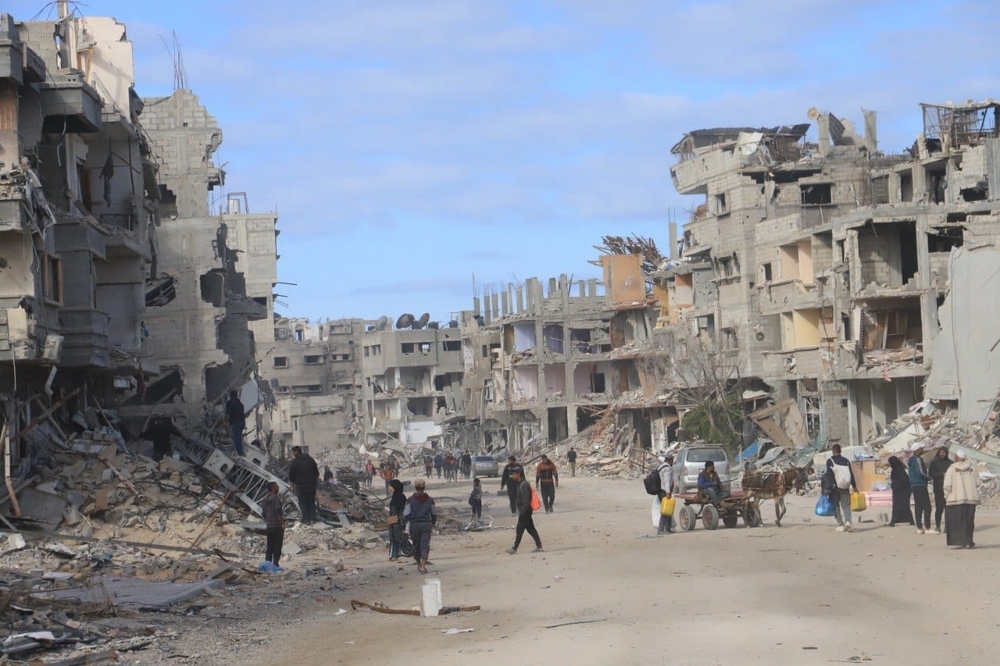
Picture credit : Mariam Abu Dagga/MSF
Translated from the French by Derek Scoins