


A machine never loses its temper and does not judge, but it does not take responsibility for anything either. From significant audience growth to the risk of participation washing, three practitioners examine how artificial intelligence is reshaping the trust-based relationship that binds humanitarian organisations to the communities they serve.
When asked about his 2024 essay, Dario Amodei, co-founder and Chief Executive Officer of Anthropic, warned: with artificial intelligence (AI) capable of contributing to the greater good of humanity on the one hand, and technology that could profoundly undermine human societies on the other, the likelihood of seeing either scenario come to pass may ultimately hinge on just a handful of decisions.[1]Interview with Ross Douthat in Interesting Times, a New York Times podcast, 12 February 2026, https://www.youtube.com/watch?v=N5JDzS9MQYI. The title of Dario Amodei’s book, Machines of Loving … Continue reading
Among promises of improved interventions and mounting resource constraints, AI is now making inroads into the humanitarian sector, prompting calls to take a step back and consider its implications. While its use – in the form of predictive models, early warning systems or satellite analyses – is nothing new, its rapid development, particularly through large language models (LLM) and generative AI tools, heralds a shift in both scale and scope.
This changing landscape is profoundly transforming the way organisations interact with their communities. In a context where accountability to affected populations (AAP) depends on the quality of this relationship, these transformations raise a key issue: to what extent can AI strengthen the trust and participation of populations or, conversely, redefine them – with a risk of weakening them – through what would instead amount to participation washing?[2]Stella Suge, Sarah W. Spencer, Nyalleng Moorosi et al., From experimentation to engagement: on the paradox of participatory AI and power in contexts of forced displacement and humanitarian crises, … Continue reading
Without attempting to provide an exhaustive assessment of all AI uses, this article aims to explore this ambivalence and analyse the extent to which AI is becoming a new interface between humanitarian players and their communities.
AI as a new humanitarian interface with our communities
Over the past ten years or so, use of AI in community outreach has evolved at a rapid pace. Two broad categories can be distinguished: systems that interact directly with populations (pop facing) to share information or collect feedback; and systems behind the scenes (back-office) – therefore less visible – that make it possible to transcribe, translate and analyse the information at a different scale.
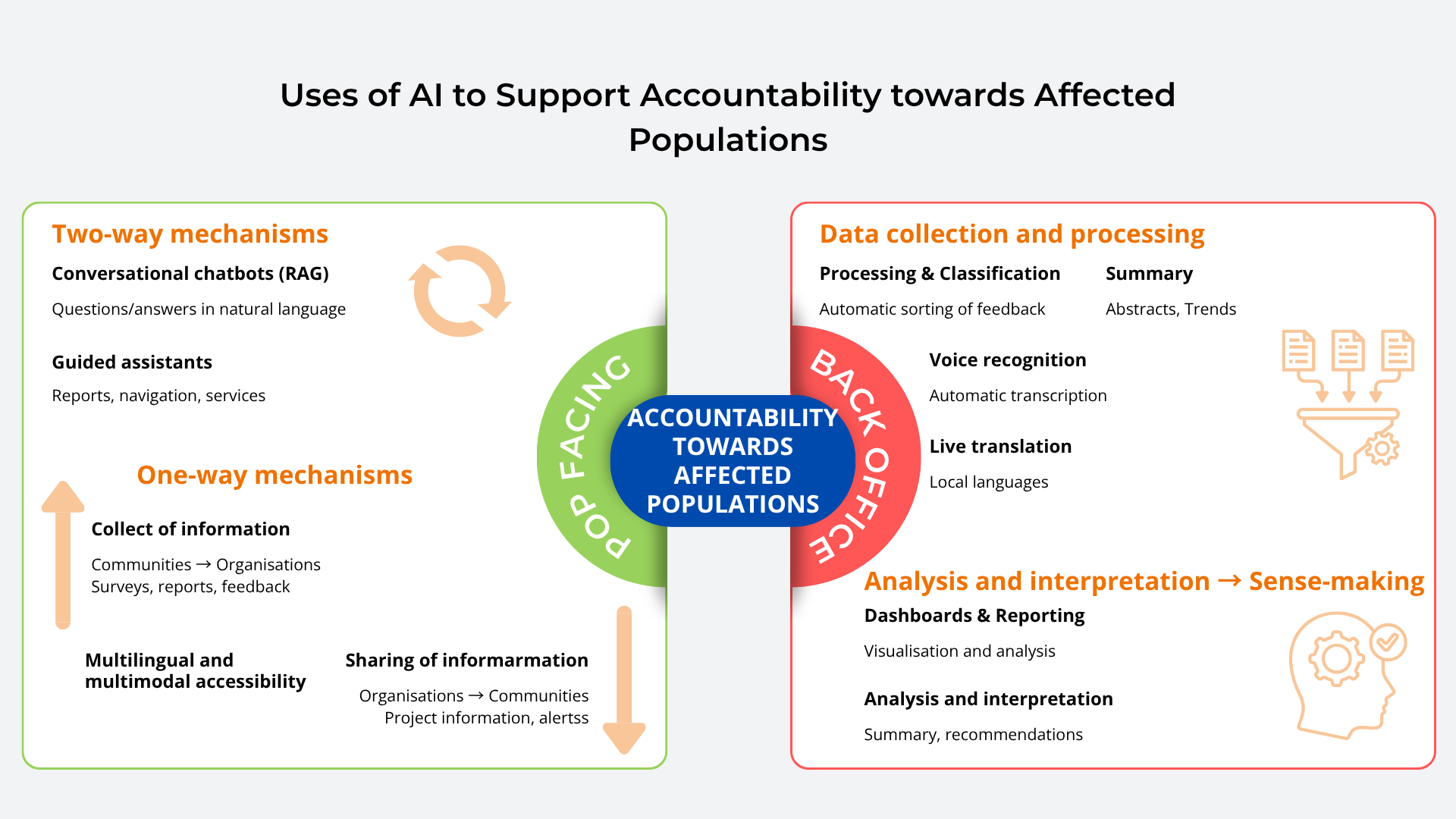
Overview of systems that interact directly with populations
For communities – and individuals in general – the most visible change is the ability to ask a digital device a question directly, get information quickly or express a need via a familiar platform. Chatbots[3]A combination of ‘chat’ and ‘robot’, a chatbot is a computer program that simulates human conversation via text or voice [editor’s note]. are now the most common form of this type of interface. What may look like similar conversational interfaces often reflects different technical choices: some chatbots guide the user through predefined paths and pre-validated answers, while others use LLMs to deal with free-text questions, in real time and in multiple languages.
|
Chatbots The technical breakthrough came in the form of LLMs, of which GPTs (Generative Pre-trained Transformers) are the best known example. A language model is first pre-trained on a large corpus of texts in order to learn how to produce the most likely outcome to a given statement. It is then adjusted to become a conversational assistant, drawing, in particular, on samples of human dialogue and feedback, a method known as Reinforcement Learning from Human Feedback (RLHF). This combination explains both the flexibility of these tools and their limits: they can produce, translate, summarise, classify, reformulate or respond in a single interface, but the fluid and convincing response is not necessarily accurate. |
Humanitarian organisations were quick to adopt these tools. Signpost, a humanitarian information platform launched by the International Rescue Committee and Mercy Corps in 2015, has evolved into Signpost AI,[4]See: https://www.signpost.ngo which has, since 2024, incorporated a multi-agents architecture based on several LLMs. Clara,[5]American Red Cross, Meet Clara, the Red Cross Chatbot, https://www.redcross.org/about-us/meet-clara.html the chatbot of the American Red Cross, is based on decision trees connected to institutional databases with, to date, no incorporation of generative AI. These two examples – both of which are relevant to our communities – show that conversational tools can cover distinct needs: greater flexibility when formulating requests and responses, or greater upstream control over the information given.
Integration of LLMs expands the scope of these interfaces when they link to content validated by the organisation. This is the principle of Retrieval Augmented Generation (RAG): the system first searches for information in a document database, and the model then formulates an answer appropriate to the question asked. This architecture provides easy access – at any time and in several languages – to information on services, eligibility criteria or referral procedures, although this alone does not guarantee that the response is accurate or appropriate in a sensitive situation.
Sometimes, this type of application can even boost accountability by reaching audiences within communities unable to access traditional services. An example of this is Wysa, a mental health chatbot,[6]Sarah W. Spencer and Caroline Masboungi, “Enabling access or automating empathy? Using chatbots to support GBV survivors in conflicts and humanitarian emergencies”, International Review of the … Continue reading which provides “last resort” support (particularly for loneliness or anxiety issues) for populations with no access to human therapists.
By opening up formats that are less constrained than traditional questionnaires, AI also provides more ways of giving feedback. Voice messages, free-form text messages or exchanges on messaging apps can be collated and processed automatically via channels already used by communities, such as WhatsApp or interactive voice response systems. The digital platform of the United Nations Refugee Agency in Jordan dedicated to community accountability[7]UNHCR, AI-Driven Digital Feedback AAP [no date], https://jordanapps.unhcr.org/innovation/app1.html and the Digital Engagement hub (DEH) in Colombia[8]Initiative 510, “‘The Red Cross Listens to You’: DEH in Colombia”, The Netherlands Red Cross, 15 December 2025, https://510.global/2025/12/the-red-cross-listens-to-you-deh-in-colombia illustrate this shift towards multi-channel systems. Machine translation and voice recognition can make these mechanisms more accessible to people who cannot read or write or have disabilities. However, they can further exclude those audiences who have difficulties accessing to digital technology or who do not have secure access to these channels.
In addition to these direct mechanisms, some approaches focus on indirect engagement with communities, notably via social media listening. As these methods help identify community concerns, needs and perceptions, they can be invaluable for certain early-warning systems or for identifying trends without recourse to direct data-collection in the field. Consider, for example, a project run by the International Federation of Red Cross and Red Crescent Societies, and the 510 initiative in the war in Ukraine.[9]The Netherlands Red Cross, “Enhancing Disaster Response through Social Media Listening: An Innovative Tool for National Societies”, Reliefweb, 22 February 2024, … Continue reading All these uses are therefore invaluable for boosting the relevance of humanitarian activities and thereby, indirectly, their accountability to the population.
Overview of back-office systems
While these devices transform organisations’ ability to interact with their communities, they also rely on underlying data-processing infrastructures. It is in these back-office mechanisms that an essential part of the way in which organisations inform, listen and interact with their communities is reconfigured.
This capability is based on what are now almost instantaneous operations that transcribe, translate, classify and structure data. In particular, these processes make it possible to integrate forms of expression that have hitherto been difficult to exploit, such as voice messages or contributions in local languages, while facilitating their standardisation across the board. The systems that connect with communities also rely heavily on these software components. For example, the AAP tool makes it possible to transcribe and categorise refugees’ voice messages, and then structure them to allow for systematic exploitation. These developments boost organisations’ ability to expand the gathering of feedback from their communities, while making this data usable on a large scale.
In addition to processing, AI is also transforming organisations’ ability to interpret and make sense of this data. It makes it possible to move from simply accumulating information to a more dynamic analysis geared towards decision-making. In particular, these tools make it easier to identify trends, prioritise needs, detect weak signals and even correlate information gleaned from multiple sources. They thereby help accelerate and refine decision-making processes, especially in contexts characterised by high volumes of data and significant time constraints.
“AI does not just process data from communities; it also plays a role in how this data is interpreted, prioritised and translated into action.”
Further upstream, AI also helps feed into prediction tools. In GiveDirectly’s project,[10]GiveDirectly, “AI Supported Triggers for Cash Transfers”, NetHope [no date], https://nethope.org/case-studies/ai-supported-triggers-for-cash-transfers-givedirectly-2 identifying flood-risk indicators in Bangladesh and Nigeria acts as a trigger to activate cash transfers even before a disaster strikes. This illustrates the shift from reactive models to more proactive approaches, allowing populations to anticipate the effects of an upcoming event, for example by evacuating livestock or fortifying homes.
Taken together, these uses reflect a significant shift: AI does not just process data from communities; it also plays a role in how this data is interpreted, prioritised and translated into action. Without attempting to provide an exhaustive overview of all the uses here, we can clearly see their potential to improve the quality of interventions and associated accountability to the affected communities. These burgeoning practices, however, raise serious issues about the relationship between organisations and their communities.
Trust and participation: two prerequisites for using AI to promote accountability
Community accountability is primarily based on the responsible exercise of power and this power can only be exercised legitimately on one condition: that there is trust. It is this that allows communities to share their data with organisations – and thereby give them a real form of power.
The introduction of AI into this relationship is not without consequences. It can strengthen this relationship or weaken it. In this respect, the experiment carried out by Solidarités International (SI) with the SOLIS bot in Lebanon is revealing: a significant proportion of users said they preferred interacting with the chatbot rather than with human staff on certain topics. This result reflects less a rejection of human contact than a form of trust in the organisation itself – trust that allows, and even facilitates, data-sharing. It is interesting to note that SI deliberately rejected generative AI for direct contact with users, preferring a decision tree with messages written and validated by teams of humans.[11]Valentin Pistorozzi, « Le SOLIS bot, un lien permanent avec nos bénéficiaires », Défis Humanitaires, 30 janvier 2026, … Continue reading When designed with a genuine focus on cultural and linguistic adaptation, these tools can help users feel understood, turning AI into a “familiar” interlocutor rather than reducing it to a “foreign tool”.
This trust, however, is fragile. In critical contexts, such as applications for asylum, access to essential services or health information, incorrect information generated by AI can have serious consequences and permanently undermine the organisation’s legitimacy.
While trust is a prerequisite for accountability, genuine participation is a prerequisite for trust. It is precisely on this point that AI raises the most demanding questions. Joint development with communities and representativeness are the first prerequisites for the legitimate deployment of AI. Involving the population from the moment the problem to be solved is defined, and not just during the testing phases, ensures that the tool reflects its real values and needs, not those that organisations project onto it. This requirement is all the more pressing as AI models are most often trained on data from Western and predominantly English-language publications,[12]Yann Tao, Olga Viberg, Ryan S. Baker et al., “Cultural bias and cultural alignment of large language models”, PNAS Nexus, vol. 3, no. 9, p. 346, 17 September 2024, … Continue reading introducing linguistic and cultural biases likely to marginalise the populations of the Global South or miss out on the nuances of the local language.
To counter this phenomenon, interesting dynamics are emerging, such as the Masakhane project[13]The project leaders made a simple observation: 2,000 of the world’s languages are African, yet they are barely represented in technology, with English and other European languages clearly enjoying … Continue reading which aims to broaden access to resources in local languages when using language models, or Clear Global’s “4 Billion Conversations” project, which aims to bridge the digital linguistic divide in order to promote under-represented languages.[14]Clear Global, 4 milliards de conversations [sans date], https://clearglobal.org/fr/4-milliards-de-conversations
Participation also implies a rebalancing of power relations. AI must not become an extraction tool serving merely to gather data without providing any real benefit for communities, or to facilitate decisions made remotely on the basis of opaque algorithms; nor should it merely perpetuate the illusion of consultation without effective influence over programme choices. This risk of participation washing is real, and all the more insidious as digital tools give it the appearance of modernity and inclusiveness. Under the guise of localisation, inappropriate use of AI could, however, be akin to a form of “technocolonialism” harmful to the sector.[15]Mirca Madianou, Technocolonialism: When Technology for Good is Harmful, Polity, 2024.
Lastly, participation means maintaining hybrid systems that combine technology and human intervention. AI can free up time for teams and help process volumes of work they would not be able to manage on their own. Access to a humanitarian worker must, however, remain possible when the request concerns a right, protection or a sensitive situation. Technology can underpin the relationship, but cannot replace the responsibility to respond. Increasing an organisation’s analytical capacity is not enough: communities must be able to understand the decisions made on the basis of their feedback, challenge them and get a response.
Friction zones: what AI shifts in the accountability relationship
The digital transformation of the sector is generating real – and often legitimate – enthusiasm, as Fathi Enneji summarises. According to Enneji, project manager of the World Food Programme’s Common Feedback Mechanism, “humanitarians are increasingly adopting digital transformation [tools] to modernize communication with affected communities, get feedback and promote accountability.”[16]Suzanne Fenton, “A chatbot named Mila: Answering the call for people in Libya”, World Food Programme, 17 May 2021, https://www.wfp.org/stories/chatbot-named-mila-answering-call-people-libya
“Using AI risks shifting attention and resources from the human relationship to the tool, while creating the illusion of modernised and fantasised accountability.”
Yet this is precisely where the first blind spot is: technology, however powerful it may be, does not solve the structural problems of digital divide, unequal access and imbalances in data representation that precede its implementation. Worse, it can even hide them. Using AI risks shifting attention and resources from the human relationship to the tool, while creating the illusion of modernised and fantasised accountability. This is the “technosolutionism” trap: believing that technical sophistication offsets the lack of political, organisational and ethical conditions for true participation.
By delegating the management of community feedback to automated systems, organisations risk losing something essential: the active presence that listening requires. This is not to deny how useful automated sorting is for large volumes of data, but one question is worth asking: how does an affected community feel about interacting with an algorithm rather than a person?
Automation can help process large volumes of feedback – but it cannot replace the ability of a humanitarian aid worker to read between the lines, put a request into context or show someone they are being listened to. Listening is not just about recording information: it is also an act of recognition. When a chatbot becomes the main – or even the only – entry point of a feedback mechanism, the organisation risks making access to a machine the condition for listening.
This tension is particularly acute in situations of extreme vulnerability, particularly where protection or psychosocial support are involved. An interface can inform, refer or report an emergency, but it cannot take on the role of a support relationship.
A second source of friction relates to infrastructure. Computing and hosting capacity are concentrated in the hands of a few private stakeholders (mainly in the United States) engaged in a race to capture a strategic market. Yet responsible data management requires an organisation to be able to explain, at any time, how data is collected, stored, processed, shared and deleted. When this chain depends on entities that are opaque and difficult to audit, the trust promised to communities is based on an infrastructure that organisations no longer control.[17]Giulio Coppi, “Buyer beware: how AI is infiltrating humanitarian aid operations”, Access Now, 26 March 2026, https://www.accessnow.org/ai-infiltrating-humanitarian-aid
This dependence really comes to the fore when the same technologies find themselves in a different setting. According to several surveys, during the United States (US) strikes on Iran in the spring of 2026, Palantir’s Maven Smart System used workflows incorporating Anthropic’s Claude model and allowed some twenty analysts to generate up to 5,000 target recommendations per day.[18]For more about the Maven Smart System and its use in US operations in Iran, see in particular Palantir, « Multi-Domain AI: The Future of Command and Control | CDAO at AIPCon 9 », YouTube video, … Continue reading With a few minor adjustments, these are the same technical components that humanitarian organisations currently use in their operations. This proximity should not point-blank prevent the tool being used, but requires a clear assessment of what the sector delegates, and to whom.
This responsibility also extends to what the interface leaves out of the picture: the annotation or moderation work sometimes outsourced under precarious conditions, especially in the Global South, as well as the material and environmental cost of systems deployed on a large scale. The ethical safeguards put in place are often calibrated to comply with the laws and expectations of the US domestic market, offering uncertain levels of protection to people located outside the service provider’s country.[19]Félix Tréguer, « La bonne conscience de la Silicon Valley », Le Monde diplomatique, mai 2026.
The answer cannot be just a legal or ethical one. It must involve enhancement of in-house technical skills, with staff able to audit flows, implement models, assess their limitations and negotiate as informed stakeholders. There are alternatives. It is generally observed, therefore, that the best so-called “open-weight” models catch up, with a lag of a few months, with the performance of the most advanced closed models developed by big tech, with the gaps varying depending on the task.[20]For more on narrowing the gap with open-weight models, see Luke Emberson, “Open-weight models lag state-of-the-art by around 3 months on average”, Epoch AI, 30 October 2025, … Continue reading They allow controlled hosting, sector-specific pooling and more transparent digital commons. These approaches require skills, maintenance and joint governance, but they refocus the issue: not just which tool to use, but who controls the technical conditions that underpin trust. Given that many organisations currently have no formal AI policy (according to a study carried out in March 2026, only 35.7% of the organisations surveyed have such a policy)[21]Ka Man Parkinson, “How are humanitarians using artificial intelligence? The case for governance and local leadership”, Humanitarian Leadership Academy, 14 April 2026, … Continue reading, this raises doubts about their ability to deal with the subject adequately – all the more so in a context where local and national non-governmental organisations (NGOs) are playing an ever-increasing role, but where the technological environment of the sector is also increasingly advanced and complex, therefore requiring significant resources to address the matter effectively.[22]CartONG, Au-delà des chiffres : Concilier innovation, éthique et impact, study published by Alnap, septembre 2024, … Continue reading
Are we to entrust the future of humanitarian aid to “machines of loving grace” or should we collectively decide what can be entrusted to them?
A humanitarian hotline that is always available; a voice that answers, 24/7, in the language of the person speaking to it. It assesses needs, directs the caller to the nearest humanitarian resource and handles a complaint addressed to a particular organisation. This voice never loses its temper and does not judge. All the signs seem to suggest someone is listening. But there is no one there. In the words that Amodei himself took from Richard Brautigan, a “machine of loving grace” – one that is always available and works efficiently.
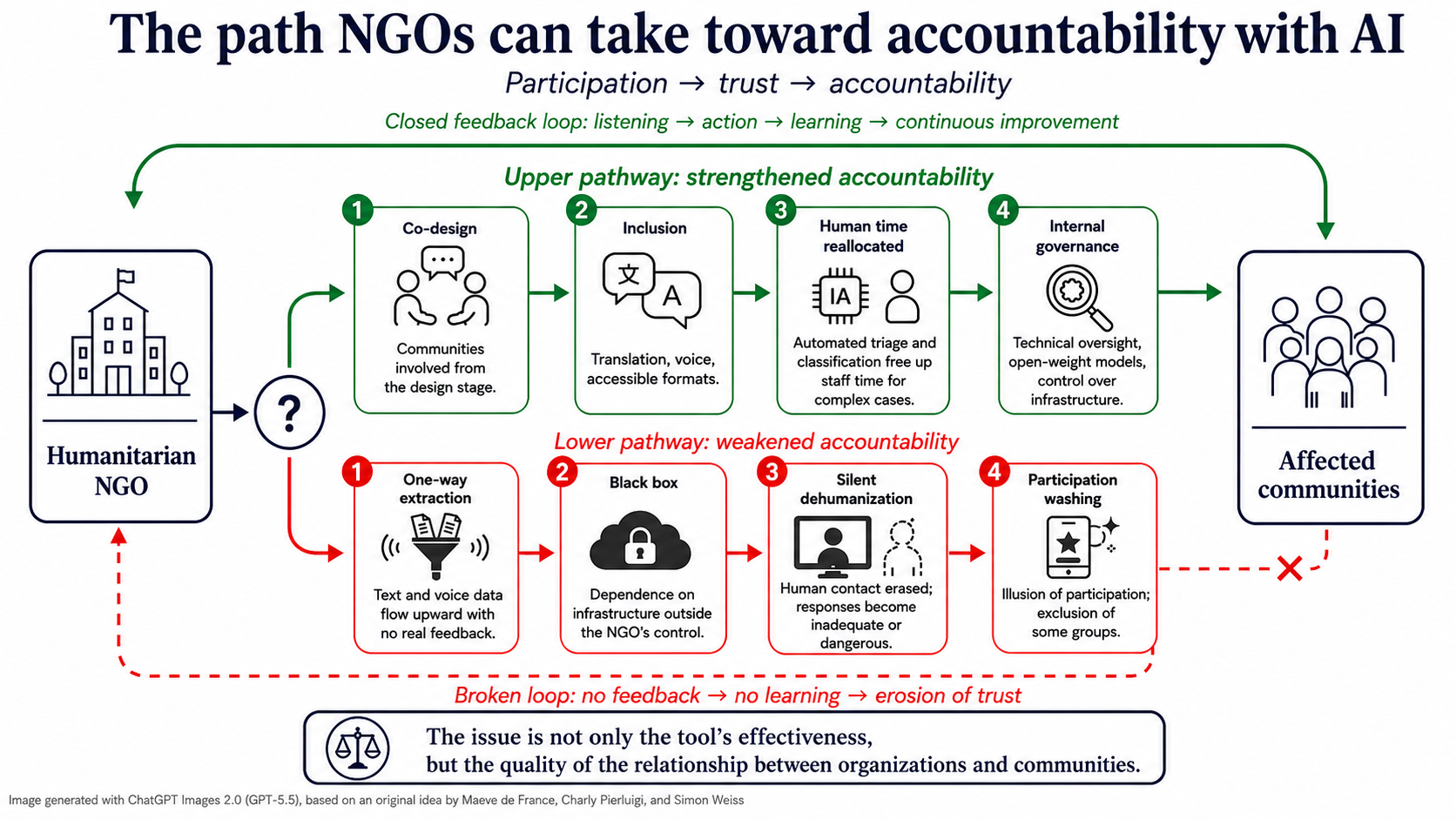
For humanitarian organisations facing ever-increasing needs, the technical possibilities of AI are immense. The machine acknowledges neither doubt nor error and this is precisely where the fantasy of “machines of loving grace” breaks down: in order to engage and, ultimately, be accountable, they must be able to recognise their own shortcomings. Accountability is not about the perfection of an uninterrupted service; it is about acknowledging an operational limitation that forces an organisation to be transparent: to say what it can do and, above all, to take responsibility for what it cannot do.
Confusing the production of text with actual communication reduces accountability to a technical function when it is actually a political act: a recognised power dynamic. This shift is already happening, driven by the funding crisis, via technological consolidations and the regulatory gap that is seeing AI applications roll out faster than the frameworks able to govern them. The real question, therefore, is not simply which model to use, but why use it, in place of what, for whose benefit, and how can communities challenge decisions that affect them? AI must uphold the principles of responsible data management and respect for human rights[23]CartONG, Toolboxes, Responsible Data Management, Section 5.2 “Data subject rights,” 13 September 2022, … Continue reading – “Do No Harm”, consent, data minimisation, not allocating aid based on an automated decision – and boost the ability of teams to listen, rather than take their place.
This means communities must be kept in the loop from the very outset as stakeholders rather than mere data providers. This implies maintaining genuine access to a human point of contact for matters relating to protection or fundamental rights, while accepting that such access has cost implications and cannot always be optimised. Finally, this requires investing in the in-house skills required to audit systems whose biases or infrastructure are not always fully understood by the organisations themselves.
Artificial intelligence has made its way into the humanitarian sector and is here to stay. It remains to be decided collectively – beyond a process of legal compliance –[24]European Commission, The Artificial Intelligence Act (EU AI Act), 2026, https://artificialintelligenceact.eu. Similar to the General Data Protection Regulation (GDPR) of 2019, this legislation is … Continue reading what can be entrusted to it, on the understanding that this very decision is already an act of accountability. Relying on “machines of loving grace” would be tantamount to embracing the idea that humanitarian action is able to listen to everything, understand everything and respond to everything. The challenge is not about humanising machines, but about not dehumanising humanitarian action.
Picture credit: Getty Images/CICR
Translated from the French by Derek Scoins