
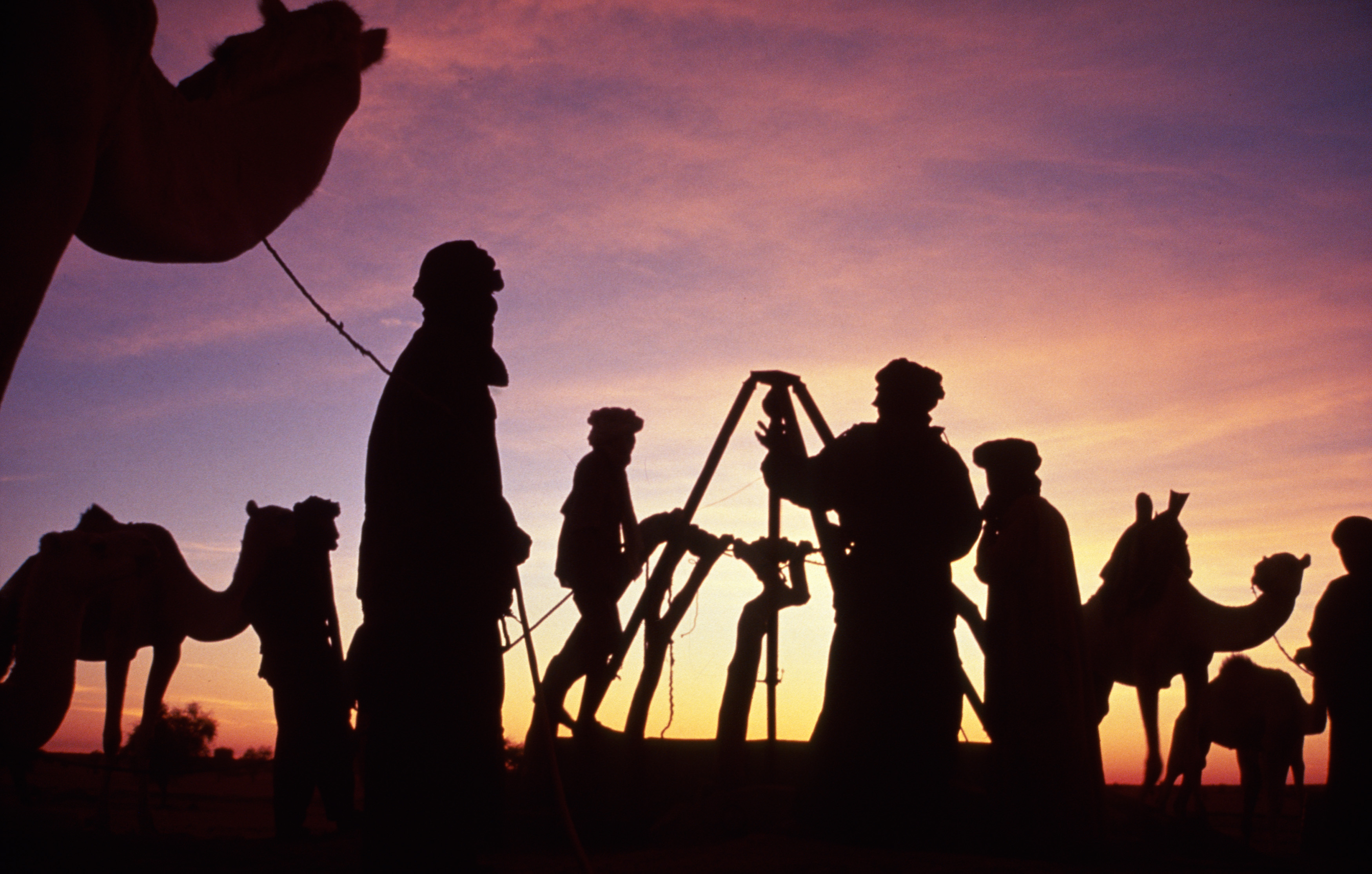
Viewed from Europe, Libya is often perceived as little more than a bottleneck from where thousands of migrants try their luck crossing the Mediterranean. Yet another tragedy is taking root in the south, far from the coastline: that of the Tuaregs in the Fezzan region, who have long been settled in the region and yet are stateless. They are paper ghosts at the heart of a state that still refuses to acknowledge them.
For decades, thousands of Tuaregs have been living in a total legal vacuum in the heart of the Fezzan region in south-west Libya. Generations of Tuaregs have put down roots in the area, yet they remain deprived of citizenship, civic rights and access to basic services. For this community, their lack of citizenship is not an administrative glitch, but the result of a long history of unkept promises and political marginalisation, worsened by the collapse of the state in 2011. This article explores the situation of these “paper ghosts” through the voices of those fighting to get them recognised.
The erasure of a thousand-year presence
The Tuaregs are one of the Amazigh (also known as Berber) peoples of the Central Sahara. Historically nomadic, they moved around the land now divided between Libya, Niger, Mali, Algeria and Chad well before modern-day borders were established. Cross-border journeys have long been part of daily life in Fezzan, the sprawling yet sparsely populated desert region that comprises almost one-third of Libyan territory.
“The desert is not a barrier for this community, but a homeland in which movements were determined by seasons and trade, well before colonial borders were mapped out.”
The prevailing narrative often tends to present the Tuaregs as recent migrants who have arrived as a result of the crises in the Sahel. However, they have actually been in the region for a thousand years. In the words of Abdulbaqi Hamdi, a young Libyan Tuareg who was born stateless: “When people ask me ‘when did you arrive here?’, I find it hard to answer the question. Because we haven’t ‘arrived’. We were already here. This land – from southern to northern Libya – is our home. We have always been on the fringes of the state, but we have never been outside the country.”[1]The interviews were conducted by telephone between December 2025 and May 2026. The desert is not a barrier for this community, but a homeland in which movements were determined by seasons and trade, well before colonial borders were mapped out.
The Tuaregs’ current statelessness originated in the first years of Libyan independence. In the 1954 and 1964 censuses, the administrative commissions did not manage – or did not want – to reach the isolated nomadic peoples in the far south. This original bureaucratic sin turned a cultural identity and way of life into an administrative anomaly.
From the 1970s, the droughts that affected the Sahel speeded up the movement of people to southern Libya. Families from Niger or northern Mali came to areas in which long-standing Tuareg communities were already living. Many settled permanently in Ubari, Sabha and Ghat. However, their Saharan way of life collided with a state approach based on registers, identity documents and a set location.
This initial absence of administrative recognition generated a situation that would gradually turn into a political impasse.
A “broken pact”
The Tuareg issue became an instrument of power under Gaddafi’s regime. The “Guide” exploited the Saharan communities while keeping them in an administrative grey area. As Mohamed explains, “many were recruited into the army or the paramilitary groups, with the promise of subsequent naturalisation. However, this promise has never been fulfilled.” Mohamed, a former tourist guide and then a community mediator for non-governmental organisations (NGOs) in Fezzan, is now a refugee in France, and wished to remain anonymous on security grounds. This partial integration has created a generation of soldiers who served the country but never became fully fledged citizens. “Gaddafi deliberately maintained this ambiguity to keep these communities under control, in a form of administrative blackmail”, he added. Abdullah Bashir Amzough, a civil society activist, also described a relationship based on unkept promises, saying that “the Gaddafi regime exploited the Tuaregs in its wars against Chad, and in the conflicts in Libya and Syria. It promised them they’d obtain their rights in Libya and it’d support the Tuareg movements in Niger and Mali.”
He says that these commitments have never been upheld. He also states that the Libyan authorities sought to dilute Tuareg demands for recognition by espousing a Pan-Arab concept of the nation:
“The Tuareg leaders refused to be incorporated into ‘Arab nationality’ because they were firmly attached to their Amazigh identity, language and culture. This gave the Gaddafi regime an additional reason to ignore their demands.”
Majdi Bouhanna, a human rights activist and rapporteur at the Supreme Social Tuareg Council, explains that these families were listed on what is called “provisional civil registers”. The 2005 census, which was supposed to officially record their regularisation, was deliberately frozen, leaving thousands of files on hold. “The issue has remained stuck in the administration’s pending tray,” says Majdi Bouhanna. “Legally, many issues could be sorted out. But politically, there has never been any real will to see it through,” he says. According to the activist, around 14,000 families were affected at the last official census in 2005 – a figure that is thought to have increased to 16,000–17,000 families today.
2011: from marginalisation to suspicion
The fall of the Gaddafi regime in 2011 dramatically changed the situation of the Libyan Tuaregs. In the post-revolution chaos, many were viewed as being part of the old regime because of their links with the army and Gaddafi’s security forces. This stigmatisation has direct consequences. Regularisation processes have been halted, security checks are increasing and the issue of citizenship is now considered from a borders and national security perspective.
“This atmosphere of hatred has led to serious violations and acts of revenge committed against innocent civilians in the Tuareg community,” says Abduallah Bashir. “When a Tuareg is killed in the war, he is classed as ‘unknown’. When a Tuareg is captured, he is viewed as a mercenary,” he says. This permanent suspicion impedes any legal progress on this issue.
In 2014, the law on the “national identity number” made this situation even more critical. This number, which is contained in the centralised identification records held in the national database, is used to identify any individual and confirm their identity with all state institutions. No state body may issue any document or provide any service until the individual has been assigned this number.
Without a national number, it is impossible to access essential rights: getting a passport, voting, owning land, receiving social benefits and obtaining a business licence. This reform has transformed a long-standing problem into systematic exclusion.
“The national identity number is the magic key to everything in this country,” says Abdulbaqi Hamdi. Under pressure from protests held in the south, particularly after the closure of El Sharara oil field in 2013, the authorities created a temporary “administrative number” for families on the provisional registers. However, this temporary number only grants limited rights: some healthcare, partial access to education and the payment of some public sector salaries. Still, holders cannot obtain a passport, vote, open a bank account freely or own property in the normal way. This partial citizenship fuels a deep feeling of humiliation. Abdulbaqi Hamdi deplores the situation:
“Our grandparents, our parents and now our generation have all tried the possible avenues to obtaining an identity card or passport. The procedures were an endless labyrinth: investigative committees, documents demanded to prove our presence decades ago. Every attempt ends in refusal or indefinite postponement, under the pretext of a ‘security file review’ or ‘insufficient evidence’.”
Living without legal status
Statelessness does not only show itself in legislation. It affects every aspect of daily life. In districts like Talaqine in Ubari or al-Tayori in Sabha, the lack of administrative recognition takes the form of spatial exclusion: dilapidated infrastructure, limited access to public services, makeshift buildings and low levels of public investment.
Access to healthcare is one of the most visible dimensions of this exclusion. Abdullah Bashir Amzough’s father provides the most tragic example. He says he went with his father, who had cancer, to Sabratha Hospital near Tripoli in 2005. Upon arrival, the doctors demanded a family record book or passport in order to admit his father. “My father was not admitted for cancer treatment because we didn’t have the required documents”, he explains. “We had to go back to Sabha, where he died a few weeks later,” he says.
Others mention treatment being refused in some public hospitals and constant administrative issues. For serious health conditions needing treatment abroad, particularly in Tunisia, the preferred destination for many Libyans, lacking a passport makes it impossible to travel.
The education system reproduces the same mechanisms of exclusion. Without a national identity number, students cannot obtain a university degree, receive a grant or pursue a career in certain professions. Abdullah Bashir says he studied for several years in private institutions before finding out his qualifications could never be officially recognised: “I was asked for an identity document I didn’t have. That was when I realised I was stateless.”
Work itself never provides stability. Public sector jobs are often inaccessible. Witnesses describe a generation caught in a vicious circle, with the lack of citizenship limiting access to education and then to the jobs market, thereby increasing dependence on local armed groups.
Even everyday actions become a challenge. Majdi Bouhanna says that “the number of discriminatory practices is growing: a refusal to register marriages, to open bank accounts and even to obtain SIM cards or death certificates so we can bury the dead.” “We live like ghosts. We exist, but our lives aren’t recognised on paper,” summarises Abdulbaqi Hamdi. This exclusion fuels a deep feeling of broken identity. “I’m Libyan by blood, history and ties to this land. But I’m not Libyan in the eyes of the law”, he explains.
Silence and repression
Local initiatives have emerged to meet the most pressing needs in response to the state’s withdrawal and the scant presence of international organisations in the Fezzan region. In Ubari, Khadija Andidi set up the organisation Nour al-Ilm following the 2014–15 conflict between the Tuaregs and the Toubou people. Her centre delivers first aid training, educational support and community assistance. “We’ve tried to rebuild something at a time when everything was collapsing around us,” she explains. However, third-sector players themselves face a lack of administrative recognition. “I haven’t been able to officially register my organisation because I haven’t got a national identity number,” says Khadija Andidi.
This gradual closure of the civic space plays a part in making the crisis invisible. Several activists describe intimidation and the risk of arrest or pressure from armed groups on those who publicly denounce the situation. Abduallah Bashir, now an asylum seeker in Algeria, explains that many activists have left Libya over the past few years. “People are scared of speaking out,” says Mohamed, the former mediator. “They may be arrested by the militia if they speak out about their situation,” he explains.
However, several protest movements did try to alert the authorities over the period from 2011 to 2020: sit-ins, peaceful gatherings and campaigns against discrimination were held and oil industry sites blockaded. Yet these protests did not lead to any lasting solutions. Several organisations are also trying to keep the issue on the diplomatic agenda in the international arena. “On several occasions here at Imouhagh International we’ve called on the Libyan authorities to resolve the issue of stalled nationalisation procedures for the 14,000 families in question,” says Ayoub Ag Chamad, the NGO’s spokesperson. “We’ve also informed each new United Nations envoy to Libya about the need to view the issue as an urgent priority.”
The organisation is firstly focusing on Libyan avenues to resolving the issue, without fully turning to the international arena for the time being. However, Ayoub Ag Chamad explains that a complaint documenting “the violations and racial discrimination undergone by the Tuaregs” has already been submitted to the International Criminal Court and that the organisation is preparing several legal cases against the leaders in power accused of impeding the naturalisation procedures.
A political crisis that is now a security crisis
This prolonged exclusion goes far beyond human rights in the Fezzan region. Indeed, the Libyan State has never really regained control of the region since 2011. The Fezzan region is now a strategic area, rich in hydrocarbons, criss-crossed by migration routes, smuggling corridors and cross-Saharan human trafficking networks, where local militia, armed groups and criminal networks operate. The marginalisation of thousands of Tuaregs, deprived of citizenship, creates a major security vulnerability in this context. Deprived of access to education, formal employment and any form of institutional protection, many young people have no choice but to turn to the informal economy or armed groups. They are often recruited as fighters, border guards or auxiliaries by the militia, without any status or guarantees.
“The marginalisation of thousands of Tuaregs, deprived of citizenship, creates a major security vulnerability.”
Mohamed highlights that “by excluding them, the state is faithfully reproducing the Gaddafi era model: using these communities as a proxy security force without ever granting them their rights”. This repeated pattern in an already-unstable region is fuelling a dangerous cycle in which political abandonment feeds anger, the armed economy and regional insecurity. “We’re told it’s not the right time and the political situation is too unstable,” says Majdi Bouhanna, citing Libyan officials. “But postponing the issue is only making the situation worse,” he says.
Ayoub Ag Chamad warns that “the Tuaregs’ patience won’t last forever” and “even if the Tuaregs are very patient, their patience can run out, like in any other human being”. For Tuareg community leaders, recognition of their citizenship would not be a concession, but an essential step towards national reconciliation. “We’re not asking for privileges,” emphasizes Khadidja, “only equality. We want to be seen, heard and live with dignity on our own land.” Fundamentally, the issue raised by the Fezzan Tuaregs is much broader than simply being a Saharan minority group. It highlights the Libyan state’s persistent difficulties in incorporating its territorial fringes, in moving beyond a security rationale and in developing citizenship that is not determined by origin, region or the legacy of the conflict. Thousands of families in Libya’s southern desert region continue to live in hope of recognition, which is constantly promised but never granted.
Picture credit: ICRC
Translated from the French by Gillian Eaton


