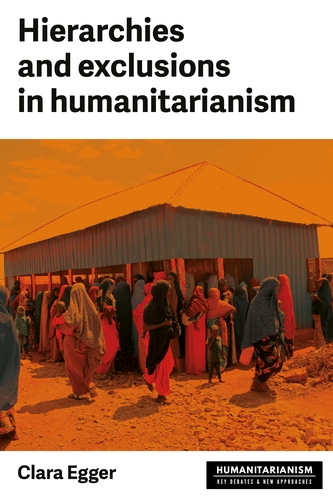
Is humanitarian aid structurally unequal? In her preface to the collective work she edited, Clara Egger deciphers the racial, geopolitical and institutional hierarchies that permeate the aid sector, calls for a critical and inclusive overhaul of humanitarianism, and makes us eager to read this essential book.
When we began compiling the contributions to Hierarchies and exclusion in humanitarianism in 2022, we were driven by the observation that across our fields of research and practice, humanitarian action – ostensibly a force for protection, humanity and solidarity – is too often entangled in the very structures of inequality it claims to address. Whether through the privileging of certain voices in humanitarian narratives, the interplay of racialised and gendered logics in aid work, or the institutional hierarchies that reproduce global asymmetries, exclusion has not been incidental to humanitarianism – it has often been built into its architecture and modus operandi.
Two years on, and as I write this in April 2025, it feels as if global events have significantly accelerated the pace of history and targeted the very values that humanitarianism stands for. These events made us question the relevance of our analyses, fearing that they would not stand the test of the current geopolitical moment. As events have unfolded, however, we have come to realise that while the world has changed in many ways, the core issues we analyse in this volume have only become more visible, more acute and, consequently, more urgent. If anything, real-world events have accelerated the relevance of our analysis, thrusting these issues into the global spotlight and underscoring the central claim of this book: that humanitarianism needs to be analysed not just as a practice of care, but as a field shaped by politics, power and inequality.
Recent humanitarian crises have highlighted the assault on international humanitarian action and on the protection of civilians in the midst of conflict. In Sudan, a civil war that erupted in 2023 has led to one of the world’s most catastrophic, yet under-recognised, displacement crises. At least 20,000 people have been killed and 13 million displaced, with nearly four million crossing into neighbouring countries. The targeting of civilians, mass sexual violence and ethnic cleansing have occurred in a context of diminishing international attention and restricted humanitarian access. Aid workers face immense risks, while local organisations and communities, who are the first responders in humanitarian crises and provide the majority of life-saving services, continue to receive minimal support. In Gaza, the humanitarian crisis has reached appalling levels. Following the escalation of hostilities in late 2023, and amid a blockade and widespread destruction, millions face severe food shortages and collapsing infrastructure. The deaths of aid workers and the politicisation of humanitarian corridors have not only raised questions about the ability of humanitarian organisations to operate effectively, but have also highlighted the dynamics of selective application of international humanitarian law. The Democratic Republic of the Congo also continues to experience cycles of violence, displacement and neglect. The resurgence of armed groups such as M23 has exacerbated an already dire situation. Attacks on medical facilities, refugee camps and local communities receive little attention in the mainstream media, underscoring a central theme of this book: that visibility is unevenly distributed and humanitarian responses often reflect geopolitical priorities more than need.
Finally, the war in Ukraine has been a painful reminder that, in many ways, the humanitarian system can mobilise rapidly when geopolitical will aligns. Since Russia’s full-scale invasion in February 2022, millions of Ukrainians have fled their homes, creating one of the largest displacement crises in Europe since World War II. The international response has been swift, well-funded and politically supported, particularly by Western governments. While this solidarity was laudable, it also exposed stark inequalities in the treatment of refugees. Ukrainians, predominantly white and European, were often welcomed with open borders and integration programmes, while migrants and asylum seekers from Africa, the Middle East and South Asia continued to face detention, pushback and suspicion at the same borders. The contrast illustrates the racialised and politicised logics of humanitarian inclusion and exclusion, and reinforces another central argument of this volume: that humanitarianism, even at its most generous, is never divorced from hierarchies of race, geography and power.
These examples – which don’t do justice to the suffering of many others around the world – are not aberrations. They are symptomatic of deeper contradictions in the humanitarian arena – contradictions that this volume explores from a variety of angles. The essays in this volume show how the normative motives and impulses of humanitarian organisations coincide with the persistence of inequalities in the governance of aid.
These humanitarian crises cannot be seen in isolation from wider geopolitical developments. The past few years have seen dramatic shifts in the global political landscape, with profound implications for humanitarian action. Under the banner of “America First”, the second Trump administration has taken steps that have reshaped the terrain of humanitarian engagement: defunding USAID, withdrawing from multilateral agreements, and framing ideals of migration, asylum, and solidarity as threats to national security. But beyond the policy changes, the Trump era has mainstreamed a political discourse that questions the legitimacy of humanitarianism itself. International cooperation is cast as suspect, diversity and inclusion as pathological, global commitments as burdensome, and compassion increasingly limited to those deemed deserving according to racial, religious, or economic criteria. These ideas are not confined to the US, but are emboldening like-minded movements around the world, from Hungary to Brazil, from India to the UK, where humanitarian principles have been subordinated to nationalism.
This geopolitical context helps to explain why our book’s focus on hierarchies and exclusion is not only timely but essential. Humanitarianism does not exist outside of politics – it is embedded in and often shaped by it. Aid is not just a technical response to need; it is also a contested field, structured by decisions about who counts, whose suffering is visible, and who has the right to intervene. The contributions to this volume aim to unpack how this situation came to be in the first place, and to suggest avenues for a long overdue reform of humanitarian governance. Of course, these questions are not new. Humanitarianism has long been entangled in the uneven geographies of global governance. But what is new – or at least more visible – is the widening gap between humanitarian ideals and realities.
One of the most striking patterns in recent years has been the growing diversity of the humanitarian arena, including actors – be they humanitarian organisations, donors or grassroots movements – who deliberately operate outside the traditional aid architecture. Their work challenges the notion that expertise flows in one direction and highlights the need to rethink what counts as humanitarian action – and who gets to do it.
This volume does not claim to offer a comprehensive solution to these challenges. What we hope it does offer is a set of critical tools – analytical, historical and political – for understanding how humanitarianism works and how it might be transformed. The essays in this book address these questions across contexts and disciplines, from anthropology and international relations to intersectional theory and postcolonial critique. Taken together, they provide a multifaceted picture of how humanitarian hierarchies are produced, maintained and sometimes resisted.
But this volume is not just about critique. It is also about possibility. By exposing the exclusions at the heart of humanitarianism, it contributes to imagining more inclusive forms of engagement. This book has been written and published at a time of overlapping crises – Covid-19, climate-induced disasters, violent conflict, forced migration, rising authoritarianism. Yet in the midst of these crises, there are also movements of solidarity, care and resistance that defy exclusionary logics and remind us of what humanitarianism can be at its best: not a paternalistic gesture, but a practice of mutual recognition and shared humanity.
We hope that this volume will contribute to this vision. That it will appeal not only to scholars and students, but also to humanitarian practitioners, policy-makers and activists committed to change. That it will serve as both a mirror and a provocation: reflecting the current state of humanitarianism while challenging us to imagine – and work towards – something better.