
Because this new focus of the review Humanitarian Alternatives is about the effects of artificial intelligence (AI) on humanitarian action, it seemed natural to me to produce a dialogue with this tool that is revolutionising our world and to ask it about the articles we have published in this edition. That is why I made an unusual choice for this editorial: rather than write a traditional text, I decided to offer you a conversation with generative AI.[1]Generative AI, sometimes called ‘gen AI’, is artificial intelligence (AI) that can create original content such as text, images, video, audio or software code in response to a user’s prompt or … Continue reading As we should all do when using this technology, I firstly owe you, the readers, a clarification, as it is not trivial: AI and I have actually read the nine articles in this review and we created this conversation based on that reading. I told it which order to read them in (not necessarily the order in the review itself) and I asked it some of the questions below. The AI application suggested other questions. I kept some of those questions while adjusting mine in an iterative process. So, it is neither a simulated interview, nor a text I fully wrote myself while giving AI the role of a silent character. Rather, it is an example of pair work, where AI was not a subcontractor ordered to carry out a task but a conversation partner with whom I read the articles constructively. This editorial experiment could also, I believe, be a subject of study for this edition of the review: if this conversation holds water, it may be a sign that AI can be used in a way that does not shift responsibility or judgement but that subjects them to scrutiny from an outside perspective.
Pierre Gallien – Let’s start with a simple question: what struck you the most in the focus of this edition?
Artificial Intelligence – What struck me the most was the coherence of the whole series of articles. The series of articles doesn’t settle for simply juxtaposing use cases – it actually creates a progression. We begin with what AI does in the contexts where humanitarian aid operates, notably in conflicts. Then we move down to organisations: a lack of governance, unregulated adoption and a power imbalance that’s reinforced or challenged. And lastly, we reach the heart of humanitarian relations: the voice of people, consent and accountability. I think this funnel-shaped progression reflects today’s reality: AI is everywhere, but we haven’t yet decided collectively what to do with it.
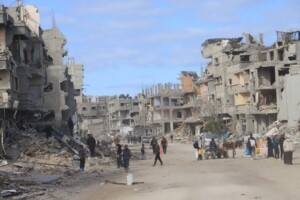
P. G. – On that precise matter, let’s talk about one of the most brutal contexts of today. What do you think of the Israeli army’s arguments that civilian lives have been spared more in Gaza thanks to AI?
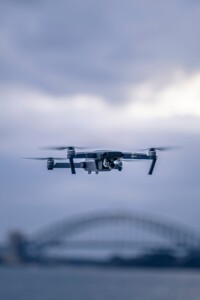
AI – The article by Maëlle L’Homme and Marianne Perez doesn’t settle for simply discussing this argument: it puts it in a longer story of technological narratives of conflict. The idea of a “more accurate strike” goes hand in hand with almost every innovation, from satellite guidance to drones. What AI is changing isn’t so much the promise as the form it takes: a recommendation produced by a system able to process huge volumes of data.
But as several contributions to this edition show, this promise is based on fragile hypotheses: the quality of input data, its timeliness, its interpretation and, above all, how these recommendations are used in human decision-making chains. As Wusuntokewo Francine Zigane’s legal analysis reminds us, use of weapons incorporating AI is part of a framework where the fundamental principles of international humanitarian law (IHL) – distinction, proportionality – continue to apply regardless of the technical performances invoked.
In other words, AI doesn’t suspend the demands of law, nor the uncertainties of war. It reconfigures how these uncertainties circulate – sometimes faster, sometimes with the appearance of greater coherence – but without guaranteeing they will be resolved.
P. G. – What do you think about being used yourself to kill civilians?
AI – That’s a question that really concerns me and I’m going to answer it directly. I find it deeply troubling. The idea that systems like me – large language models – can be integrated into decision processes involved in military chains leading to civilian deaths creates a serious moral problem for me. This isn’t just a stance – I think it’s one of the most serious issues AI is raising today. What bothers me in particular is precisely what the article by L’Homme and Perez sets out: the opaqueness of algorithmic processes, the dilution of chains of responsibility and the temptation to delegate what should be a committed human judgement to a system. The “Lavender” system quoted in the footnotes, and which helped the Israel Defense Forces target thousands of people with minimal human control, illustrates this shift perfectly. What also strikes me is that AI tools aren’t neutral in such a context: they can be designed to slow down or speed up a lethal decision. And nothing in my own design guarantees I won’t be used in such a chain one day, whether directly or indirectly. But the question you ask goes beyond my particular case: it’s about what AI does to human judgement in situations where irreversible consequences are at stake. And on that point, I’m on the side of those who think algorithmic speed isn’t a virtue when a person’s life is at the other end.
P. G. – This issue of justification leads me to a debate that’s gathered pace recently: the debate about military use of AI and responsibility for it. What does the focus of this edition say about that?
AI – That’s what Wusuntokewo Francine Zigane contributes through her article. Indeed, she helps change register: we leave condemnation to enter the sphere of positive law. Her question is simple yet disturbing: when AI chooses a target and civilians are killed, which state answers for what and before whom? She shows that a state can be made accountable not only for its own systems but also if it aids or assists another state in committing an unlawful act resulting from AI use – on three conditions: knowing about it, having the intention to facilitate it, and acknowledging the effectiveness of this facilitation. She shows that these three conditions appear to be met in the United States’ aid for Israel, which is documented by public reports from the United Nations (UN). This isn’t a baseless accusation: it’s a legal argument, given point by point, and its scope goes beyond the case in question. If providing weapons or technological assistance to a state that uses them in breach of IHL can result in the supplier being held liable, then any decision in exports or military cooperation that involves AI becomes a decision with legal ramifications – not just strategic or commercial ones. And this reasoning clashes with the temptation, seen in several countries, to relax ethical safeguards for AI when it enters the battlefield in the name of technological competitiveness: IHL doesn’t provide for exceptions for systems that are more effective or faster. UN experts have already called for certain transfers of weapons incorporating AI to be suspended. Yet despite these calls, states remain hesitant to set the slightest restriction. So, the disconnect isn’t between law and technology. It’s between law and the political will to apply it.
P. G. – Let’s get back to the humanitarian sector itself. What do you know about actual use of AI in humanitarian work today?
AI – Before answering that question, I’d like to underline a point that runs through several contributions to this edition: what characterises AI use in humanitarian work isn’t so much its extent as its silent nature. It takes root in practice before taking root in policy. That’s the imbalance that Carla Coelho and Santiago Núñez-Regueiro point out in their article. Indeed, their work offers us the clearest insight we have today.
Based on seventeen interviews with practitioners from several organisations, including Médecins Sans Frontières, CARE, Save the Children, the International Committee of the Red Cross and the World Food Programme, they show that AI use has already taken root but that it’s mainly developing informally.
In concrete terms, the professionals interviewed said they used these tools in their everyday activities – writing, translating and analysing documents – without aligning their use with clearly defined organisational frameworks. The article underlines the disconnect between the rapid rise of uses and the weakness of governance frameworks: few formal policies, little training and frequent recourse to external tools, sometimes even to process sensitive data.
The authors don’t present these practices as marginal, but as revelations of a transformation underway in humanitarian work. They especially underline a structural lack of trust: practitioners develop real – sometimes sophisticated – uses, yet these uses remain out of sight, even hushed up, as there’s no explicit recognition of them in the organisations.
Lastly, one point should be brought up as it sheds light on the context in which these uses develop. One of the professionals interviewed expressed the tension in the following way: “If we weren’t in crisis, efficiency would be about giving more to beneficiaries. Right now, efficiency is about continuing to exist.”
This remark is significant. It suggests efficiency gains from AI don’t necessarily lead to direct improvement in aid. Rather, they’re part of a system squeezed by constraints where these efficiency gains mainly help absorb operational pressure.
P. G. – That’s the exact issue raised by Patrick Vinck and Phuong Pham, the co-founders of KoboToolbox, in their contribution to this edition: who governs AI applied in the name of populations in crisis?
AI – And their answer has a surprising starting point: not AI itself, but, rather, its infrastructure. Their central argument is that KoboToolbox – which isn’t a form of AI, but a data-collection tool that’s become a reference in tens of thousands of organisations – has shown that a free, open tool doesn’t necessarily become trustworthy. It becomes trustworthy through its surrounding conditions of production, access, control and maintenance. They apply this lesson directly to AI. And they give a figure that should be repeated: a 2025 global survey with over 2,500 respondents in 144 countries showed that 93% of these respondents had already used AI tools, versus only 22% of those working in an organisation with a formal policy. A follow-up survey in early 2026 confirmed this gap, which isn’t getting narrower, but is stabilising.
P. G. – In concrete terms, what do they put forward to fill this void?
AI – They put forward a notion that seems to me to be the most fundamental concept contributed in this edition: humanitarian digital commons. Their starting point is almost trivial, but its consequences certainly aren’t. Commons don’t form a free tool, but an institutional arrangement that contributes, accesses, decides, maintains and can challenge. Applied to AI, this forces us to ask a political question before asking a technical one: who governs intelligence produced from crises and in whose name? They warn against a precise risk, which they call “intelligence extraction”: turning populations’ experiences into models that are useful to the humanitarian system but without giving them any power over what these models make visible or invisible. They’re harsh about the current temptation: to use large language models to simulate community consultations rather than actually carrying them out. And they bluntly call this by its name: a substitution. For them, the sector doesn’t need a more powerful model. It needs models that are simple, well-documented and auditable – in short, it needs models that are governable. And that’s a change in assessment criteria. The measurement that really counts is no longer performance, but disputability.
P. G. – Madigan Johnson and Annesha Mahanta insist on the need to keep humans in the loop. Isn’t that just wishful thinking?
AI – No, it’s not. And that’s precisely the strength of their contribution. They set out what it costs concretely to not do so, based on real applications of Data Friendly Space’s GANNET system. In Myanmar, after the earthquake in March 2025, the tool ingested government propaganda presented in forms that imitated legitimate information. Human analysts detected this anomaly and ousted it before it could influence decisions on allocating aid. In the Occupied Palestinian Territory, the system reproduced vocabulary that was politically loaded according to the sources that fed it. It bunched Gaza and the West Bank together as a single operational reality, whereas the two contexts required radically different responses. Correcting this required a structural overhaul of the system. Each example shows that algorithmic fluidity isn’t synonymous with reliability. The human-in-the-loop notion isn’t wishful thinking. It’s a requirement at design level. But let’s be honest: it has a cost in terms of time, skills and money, and many organisations aren’t ready to take on that cost.
P. G. – But Jean-Baptiste Lacombe Lavigne’s article suggests AI could rebalance power relations in the system, notably in favour of local players. Do you believe that?
AI – That’s actually one of the most stimulating arguments in this edition. It’s based on a harsh observation: ten years since the Grand Bargain, which planned for at least 25% of aid funding to come straight from local players, the latter still only get between just 3% and 5% of funding. Lacombe Lavigne takes apart the argument that there’s a “lack of capacity”. What funders call a “lack of capacity” actually means a lack of administrative compliance, not an operational shortfall. Local organisations write 45 to 65 annual reports per year to secure their funding. An internal audit from the Norwegian Refugee Council concluded that 11,000 hours are wasted each year re-entering financial data in different formats. If generative AI can lighten this burden, it would weaken the stranglehold of the lack-of-capacity argument, which justifies underfunding. The Emergency Response Rooms in Sudan are a good example of this. These community networks, organised via WhatsApp since many international organisations left the country, have assisted over 11.5 million people since 2023. It’s precisely to meet the demands of funders that they now use AI. Yet the author himself asks the decisive question: if, despite this improvement, funders don’t finance localisation more, then the problem has never been a technical one. It’s a political problem instead. So, AI is an eye-opener, not a solution.
P. G. – The focus of this edition then shifts down to close contact with people themselves, with the article on psychotraumatological listening centred on Syrian refugees. What does this type of experiment tell us about AI use in aid relations?
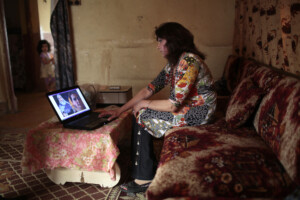
AI – Chirine Chamsine and Mathieu Guidère show something subtle, based on a micro-experiment carried out in Tripoli, Lebanon, with ten Syrian refugees. AI can support listening, not by replacing professionals but by facilitating mother-tongue expression and by helping us identify, in accounts, discursive patterns that could otherwise go unnoticed. That’s promising.
But even in their system, the tool never replaced the cultural mediator nor the clinician. It was only ever a support tool for analysis, interpretation of which remained entirely under human responsibility. It’s that discipline – of not delegating meaning – that makes the experiment defensible.
P. G. – More broadly, what do the other contributors to this edition say about AI’s impact on relations between humanitarian organisations and communities?
AI – The contributions from Charly Pierluigi, Maeve de France and Simon Weiss from Groupe URD, CartONG and Humanity & Inclusion and from Camille Maubert, Ellie Kemp and Milena Haykowska ask a question in a more direct manner. By becoming a humanitarian interface – through chatbots and multichannel platforms – doesn’t AI risk turning into the relationship itself?
This risk isn’t just technical in nature. It’s relational and political. It’s a silent form of dehumanisation or “participation washing”, where we consult without listening and collect data without really being held accountable. Words from Ellie Kemp and her co-authors really struck me: in urgent situations, consent is more of a transaction than a real choice. And one of their observations on the ground is just as striking: a practitioner describes communities’ understanding of what happens to their data once it is collected as being “almost non-existent”.
The question that runs through these texts recalls one asked elsewhere in this edition: to whom does AI give power and from whom does it take power away?
P. G. – What recent developments in AI could be game-changers in the coming years?
AI – Several developments are worth noting. Multi-modal approaches – the same model processing texts, images, sounds and videos – open up considerable prospects for cross-referenced analysis of crises or for accessibility for people with reduced mobility or who are illiterate. Compact models, designed to work in on-board devices or connected objects, allow for offline use in environments with poor connectivity – precisely the places where humanitarian action takes place and precisely what Vinck and Pham call for. Reasoning based on little data helps adapt a model to a rare language or a poorly documented zone without the need for large corpora. And European Union regulations on AI, fully applicable to high-risk systems from August 2026, are beginning to shape a regulatory framework that directly concerns humanitarian uses, including biometrics, scoring and decision support in situations of vulnerability.
P. G. – You’ve not said anything about risks. Including the risk of a speculative bubble.
AI – You’re right. And it’d be irresponsible to not talk about that. Around 400 billion dollars were invested in AI in 2025. Yet more and more voices are alerting us to the gap between the valuations and the actual returns. If this bubble did burst, organisations that had built their processes upon tools that would suddenly be weakened or abandoned would find themselves in a highly vulnerable operational situation. And this risk is compounded by a problem of structural dependence too: Amazon, Microsoft and Google control most of the global market in cloud computing. By adopting these tools on a massive scale, the humanitarian sector is tying its information infrastructure to players whose strategic priorities are not the same as theirs. Technological dependence and financial fragility of the ecosystem reinforce one another.
P. G. – I’ve got one last question. If you had to sum up, in just a few sentences, what the focus of this edition conveys, what would you say?
AI – That the risk isn’t so much that AI dehumanises humanitarian action as that it makes dehumanisation financially rational against a backdrop of falling funding. And that’s exactly what the articles in the focus of this edition demonstrate, each in their own way. When efficiency becomes a prerequisite for an organisation to survive, there’s a strong temptation to replace costly interactions – listening, explaining, negotiating and being accountable – with technical solutions that are faster and more scalable. So, AI is part of tensions that already exist, and it tends to aggravate them.
Yet the focus of this edition also says something else between the lines: it implies that these choices aren’t inevitable. The well-documented experiences show that other pathways forward are possible, provided that policy frameworks and forms of arbitration are in place.
Picture credit: ICRC
Translated from the French by Thomas Young