AI is undoubtedly revolutionising content creation, while also calling into question the authenticity of humanitarian testimonies. Between productivity gains and the risk of manipulation, organisations are having to redefine their practices. How can they preserve the value of authentic human stories when faced with the infinite possibilities of generative artificial intelligence? This is one of the questions being asked in a communications department like that of Première Urgence Internationale, and the author provides an enlightening analysis.
Welcome to the new world. With Veo3 you can create complete videos with moving images, dialogue and a soundtrack, just by entering a simple text request. At its annual I/O 2025 conference, Google unveiled its latest artificial intelligence (AI) tools, demonstrating another creative step forward.[1]The annual Google I/O conference was held on 20 and 21 May 2025 in Mountain View, California. See https://www.youtube.com/live/o8NiE3XMPrM?si=4e9HDzRPmra98Q4H AI is a revolution that still raises many questions about the place left for human beings in the face of these technological developments. With the rise of methods of generating and modifying images and stories, how can we distinguish a tangible reality from an artificial construct? At the heart of these concerns, the value of humanitarian testimony takes on another dimension. These inventions invite us to question our ability to interpret human realities as faithfully as possible, while the technology can serve, as well as threaten, the very essence of the humanitarian commitment to protect lives. We will start by looking at how a testimony is constructed based on stories. We will then look at the various types of processing made possible by AI, its influence on human stories and the possible questions that AI raises about our practices.
From stories to testimony
Before any humanitarian action is deployed in the field, reliable, objective and carefully verified information and data must be gathered. This brings understanding of the intervention context and makes it possible to respond in the most appropriate way to the needs of a population in a critical situation. The stories collected contribute to the quality of the service that will be provided by aid workers. The more accurate and authentic this information is, the better tailored the programme can be to access health, sanitary services and water, to name but a few examples.
A question of credibility and accountability
These stories are essential to diagnose real needs, and in particular to ensure accountability to the communities in need. Humanitarian organisations use a specific Monitoring, Evaluation, Accountability and Learning (MEAL) methodology, which helps them to produce and use data in an ethical way that protects the people receiving aid. For example, a complaints reporting mechanism makes it possible to identify and prevent certain abuses that could be damaging to the public and to correct them when they occur. The organisation’s credibility and, above all, its responsibility are at stake if this feedback is not taken seriously or handled correctly.
“An individual’s inspirational story helps establish a relationship of trust between communities and the humanitarian teams deployed in the field and increases the chances of effective response to an urgent need.”
These stories will help to build a testimony, which in turn will increase the social impact of an action. An individual’s inspirational story helps establish a relationship of trust between communities and the humanitarian teams deployed in the field and increases the chances of an effective response to an urgent need. When Rukiya, a resident of the Afar region in Ethiopia, talks about how her first son was cared for in a nutritional stabilisation unit, she makes it possible for other women to call on this type of service in a region heavily affected by drought and armed conflict. “I tell them that their children can heal too. Like mine”.[2]Première Urgence Internationale, Ethiopia: responding to malnutrition locally, 21 May 2025, https://www.premiere-urgence.org/en/news/ethiopia-responding-to-malnutrition-locally This relationship of trust will not only strengthen the organisation’s credibility in the field, but will also make it easier for potential donors to provide financial support for this type of action and to keep it running longer.
Sparking emotion and empathy
Stories are the raw materials used by a humanitarian organisation’s communications department, which is responsible for running campaigns to gain visibility, raise awareness and collect donations from external sources. The main leverage used for campaigns is still the emotional responses that testimony incites via its ability to arouse empathy and trigger donations. Marketing plans have been perfected over the years and now include measurement indicators allowing us to assess what is known as a “conversion rate”, i.e. the effectiveness of a campaign from the moment content is distributed to the moment a donation is received.
These practices are taken mainly from the private sector, but they are also the legacy of an emotional narrative created last century during major crises, such as the 1984 famine in Ethiopia, which generated a huge media and artistic response. On Antenne 2 [French public channel, editor’s note], Bernard Rapp introduced his 8 o’clock news with this sentence:
“Tonight, we bring to you a report on the situation in a country very far away from us. This is an account from a United Nations official who has just returned from Ethiopia. Listen to it, and this country might feel a little closer to home.” [3]INA Histoire, 1984 : La famine en Éthiopie, le Journal de 20H/France 2, Archive INA, YouTube, 30 novembre 1984, https://www.youtube.com/watch?v=a7trSy4ZpyQ
Humanitarian testimony is a way of shortening distances, getting people to feel concerned about what is happening in other places and to act as global citizens. While the artistic world has been an incredible tool for getting people involved and bringing cultures and generations together, new technology has, in turn, revolutionised the globalisation of information. The multiplication of distribution channels is leading to information saturation. Humanitarian organisations must constantly innovate in the face of increased competition for funding to stand out from the crowd and attract donors’ attention. Authentic stories from the field are still the best way to give a fundraising campaign legitimacy and to show that we are taking action where no one else is.
Testimony for History
For humanitarian organisations, testimony takes on a different value when documenting situations that are not covered by the media. The term “forgotten crisis” is often used in publications, firstly because the world has several crises playing out concurrently,[4]Our World in Data, Number of armed conflicts, World, https://ourworldindata.org/grapher/number-of-armed-conflicts most of which escape media attention, but also because a subject selected for the 8 o’clock news has to conform with an editorial line that struggles to free itself from politics.
“The arrival of social media has provided an opportunity to create new media spaces free from the arbitration of editorial boards.”
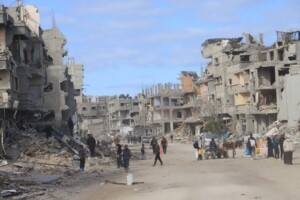
The arrival of social media has provided an opportunity to create new media spaces free from the arbitration of editorial boards. In this respect, posting a story on social media is a way of writing a part of History we do not see, or do not want to see. Première Urgence Internationale’s aim was to show a different side of the Gaza Strip and a perspective other than that of the war on terror through a portrait of Asma, Gaza’s first female archaeologist,[5] Première Urgence Internationale, Asma est la première femme archéologue de Gaza, YouTube, 2023, https://www.youtube.com/watch?v=Zq1WimVpzqE which is significant in many ways. It shows an alternative to a youth wounded by decades of war and a blockade that sounds like collective punishment. This testimony is a message to young people and to the whole world that you have to look at this part of the Occupied Palestinian Territory another way. Putting a face to the people of Gaza is a moral responsibility at a time when the conflict is descending into horror. This portrait shows images of Gaza standing tall, proud of its cultural heritage before the Israeli authorities decided to completely destroy it.
The role of testimony becomes central when humanitarian workers are no longer able to work because of security or political restrictions and when the area is off-limits to the international press. Since the massacres of 7 October 2023 in Israel and Israel’s disproportionate military response in Gaza, aid workers have taken to the media to keep a “daily report” of violations of international law and to provide evidence of them. During his appearance on France Inter [French radio channel, editor’s note], historian Jean-Pierre Filiu looked back at what he saw over a month when he visited the Gaza Strip between 2024 and 2025:
“Israel doesn’t know anything about what is happening in Gaza. Israel thinks it knows from satellites, from artificial intelligence, from interceptions. Yes, they can take images of people, but […] to really know a territory, a society and a population, you need representatives. They don’t have any representatives any more…” He reminds us that “what is happening in Gaza will have a universal value; it is something that fully calls on our humanity and our future.”[6]Jean-Pierre Filiu, « Aucun Israélien n’est rentré dans la bande de Gaza hors d’un tank depuis 2007 », France Inter, 26 mai 2025, https://www.youtube.com/watch?v=an5a5lhsMP4
The reality reported by humanitarian workers on the ground cannot be replaced by content generated exclusively by artificial intelligence. However, if we start from the premise that, from an ethical point of view, we must not create purely fictitious testimonies simply by using algorithms, we can consider that artificial intelligence is capable of increasing the scope of real-life stories collected from the field. This contribution entails both significant risks, which can alter the integrity and deep meaning of these testimonies, and benefits, provided that its use can be controlled.
AI-generated processing: what impact on the integrity and authenticity of stories?
Artificial intelligence raises the same ethical and existential questions as any other technological innovation. Seen as a revolution, just like the internet or social media, AI fascinates[7]Peter Sykes, AI & Humanitarianism – Keeping the human in humanitarianism, LinkedIn Post, 2024, https://www.linkedin.com/posts/petermsykes_ai-humanitarianism-activity-7083042829064691713-K0PQas much as it frightens people. It is becoming more widely available as it permeates all aspects of daily life. It inevitably asserts itself as a matter of course. The possible uses of AI will therefore impact the value of testimony in a number of ways.
A significant change of scale
Stories reported from the field can be instantly translated into various languages and dialects, or automatically transcribed if it is an audio recording, making them easier to process and analyse on a larger scale. This means significant time savings and a tenfold increase in international reach. Organisations with offices in a large number of intervention countries – 25 in the case of Première Urgence Internationale (PUI) – can thereby share their colleagues’ experience with all of the organisation’s staff on every continent. The speed at which AI can deliver this content exceeds human capacity in this respect alone. From a qualitative point of view, this speed also entails a major risk of altering the message or story, since the automation made possible by AI is still incapable of processing linguistic nuances or the emotions relayed in a story. This is then skewed by algorithms and can feed into existing discriminatory or societal prejudices if care is not taken to adapt what is said to the cultural codes of the societies receiving this information.
A new “weapon of mass communication”
The arrival of social media and, now, AI, has opened up more space for disinformation and the deliberate fabrication of false stories. Of course, this is not something new. Propaganda has always existed, and war propaganda, in particular, has been widely documented in academic circles. Charlotte Lepri, a former researcher at the French geopolitical think tank IRIS (Institut de relations internationales et stratégiques), uses the term “weapon of mass communication” when describing the use of propaganda by the US and the Soviet Union in the Cold War.[8] Charlotte Lepri, « De l’usage des médias à des fins de propagande pendant la guerre froide », Revue internationale et stratégique, n° 78, 2010, p. 111-118.In her view, there are three main reasons for propaganda in the media. These weapons of mass communication are:
“First and foremost, channels for disseminating ideas, and therefore a means of spreading ideology. Convincing through ideas can have just as strong an impact as convincing through force. Moreover, information, which is intangible and evanescent, knows no borders… It can find its way into other countries all the more easily because it is so difficult to counter. Finally, because it is easy for a government to use the media surreptitiously, without revealing itself and therefore without showing that behind harmless radio programmes there is in reality political influence by a state.”
These three reasons are still true today, with the difference that anyone is now capable of generating this false information as this propaganda is no longer a monopoly held by states that control the media distribution channels. The identity of a person telling a story can be misused and their words distorted by generating audio or video with AI. Authentication of stories then becomes much more complex, requiring extremely sophisticated controls to secure databases.
“Anyone is now capable of generating this false information as this propaganda is no longer a monopoly held by states that control the media distribution channels.”
In addition, the “trust capital” referred to in the first part, which an organisation manages to build and gain within a community or with donors, may prove fragile in the face of a potential scandal created by a false story. Deconstructing rumours and setting the record straight requires good crisis communication skills. An organisation’s credibility can be severely damaged. Worse still, the safety of its staff in the field and of the people receiving aid could be compromised.
An opportunity to question our practices
At first sight, you might think that our relationship with AI is either black or white: you either hate it or you love it, you use it or you shun it, you only see the positive aspects or the negatives. It was exactly the same for the PUI communications team. Opinions differed about AI, but our findings were unanimous as to its scope and the questions that AI could raise about our practices, professions and the ethics that guide us in the way we deliver our testimony. Humanitarian organisations do not have a framework to guide AI usage yet, but we cannot avoid it any more. In the meantime, AI is leading us to take a more critical look at the question of authenticity and inviting us to draw parallels with other professions that are also being challenged by these technological advances.
Respecting the integrity of information and valuing authenticity
Journalists are not the only professionals who defend an ethical framework based on respect for information integrity. This is undoubtedly the sector we should be turning to for help in drawing up humanitarian standards.
Reporters Without Borders (RSF) has joined forces with around fifteen partner organisations “towards augmented and ethical journalism”. The SpinozAI report,[9]Reporters Without Borders, RSF and l’Alliance release the Spinoza report, presenting a viable new AI tool for newsrooms. SpinozAI – Augmenting journalism with innovation and ethics, 10 February … Continue readingwhich was presented at the Paris Peace Forum in 2023, sets out the first steps towards what could serve as a benchmark. RSF is calling for AI to enhance information, rather than the other way round, for algorithms to redirect to source content and for mechanisms to be built in to ensure that errors are reported transparently. These systems must also encourage a pluralistic and diversified presentation of information by selecting sources according to objective quality and independence criteria, as defined, for example, by the Journalism Trust Initiative (JTI) standard.[10]Certification tool initiated by RSF to assess transparency and compliance with ethical standards in the news media [editor’s note].RSF also defends the idea that authentic content should be given greater value through the deployment of authentication standards in journalistic material, following the example of the Agence France-Presse (AFP), which has developed a tool to certify the origin of its photos.
“And what if, in the end, AI was actually inviting us to review the fundamentals of our testimony practices?”
Assuming we manage to establish these standards for humanitarian testimony, will we be able to create the same definition of authenticity? And what if, in the end, AI was actually inviting us to review the fundamentals of our testimony practices? It questions the way we generate our information, the way we influence the stories we receive.
Are not the positioning of a device that records, photographs or films a scene and the choice of colours, people or words with precise language following an organisation’s editorial line all cognitive and cultural biases, just as open to criticism as algorithmic biases are? Does authenticity really exist? With or without AI, collecting stories is always biased towards the socio-cultural, intellectual or philosophical filters of the person collecting the data. An important dimension in anthropology is being able to guarantee a certain distance from the subject to achieve a minimum level of objectivity. The answer to the question will not be given by the end of this article, but it does open up an interesting line of thought.
Supervising the use of AI at Première Urgence Internationale
It is clear that humanitarian organisations must not simply ban AI, but lay the foundations for responsible use, both professionally and personally, by integrating their ethical, ecological, organisational and human values. It is with this in mind that PUI has carried out a strategic reflection campaign to supervise the gradual integration of AI into its practices.
The organisation has set up an AI Committee (CIA), made up of a multi-disciplinary team that brings together representatives from different departments (Development and Innovation Department, Information Systems, Operations, Communications, HR, etc.). The role of this committee is to monitor new technology, ensure the ethical and legal compliance of AI solutions and evaluate their use by involving employees. A charter for responsible use also helps teams better define the possible uses of AI.
Will these measures succeed in protecting a method that preserves the authenticity of a testimony? We hope so, because we in the communications department are aware that it is impossible to have an exhaustive view of the practices of all 3,500 PUI employees worldwide. However, this new awareness must be incorporated into the code of conduct that is signed when they are hired. It is a moral contract that calls for individual and collective responsibility. The race to fund projects and donors’ demands to communicate excessively about the support they have provided for communities should not force our teams in the field to “produce content quickly” and tick the “visibility effort made” box, but to consider the construction of a testimony as the key element of a humanitarian and social mission aimed at inviting us humans to reflect on the imbalances that threaten our humanity and to encourage solutions that preserve it. Is the acceleration made possible by AI not an opportunity to slow down our written and audiovisual production and move towards demanding even higher-quality stories? Will the “CIA agents” of PUI be up to the task?
“How can we maintain a coherent discourse when we are defending sustainable access to essential services and resources, while at the same time taking advantage of new technology?”
AI is not a foregone conclusion, but an indicator of a significant and inevitable turning point in information processing. It is all the more inevitable that it is almost impossible to live without the internet today. However, its omnipresence in our daily lives must not distract us from the fundamental values of preserving our environment and the balance of our societies. We all know how catastrophic AI is from an ecological point of view. How can we maintain a coherent discourse when we are defending sustainable access to essential services and resources, while at the same time taking advantage of new technology? Clearly, the humanitarian sector will not escape these new challenges, but it is up to it to continue to raise awareness so as to reach a balancing point.
Translated from the French by Louise Bongiovanni
Picture credit: Melih Can