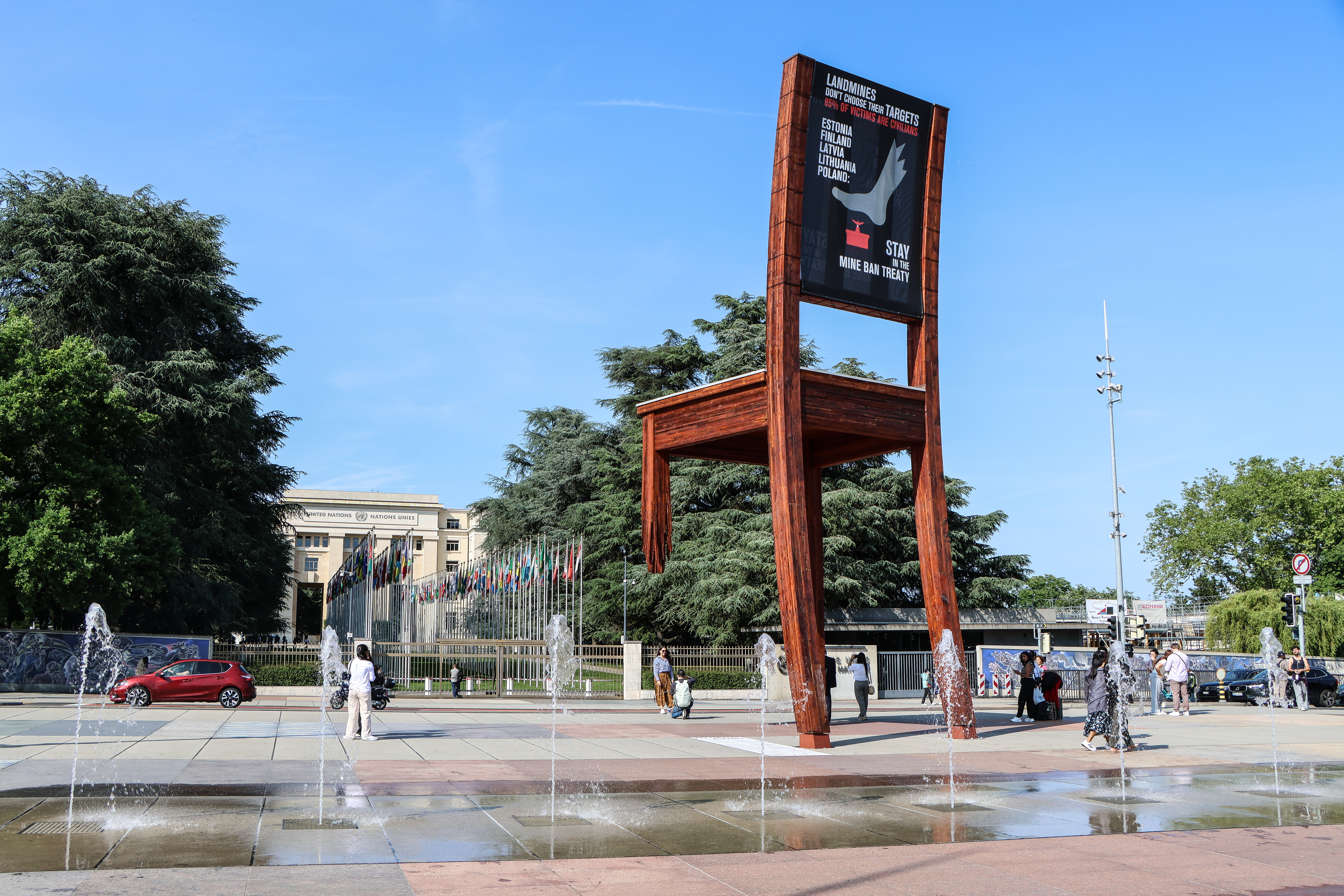

Feeling threatened by the expansionism of their powerful neighbour – which is using anti-personnel mines on a large scale in its war against Ukraine – Poland, Finland, Lithuania, Latvia and Estonia have confirmed their disastrous decision to turn their back on the Ottawa Treaty. As regards Ukraine itself, the country has announced its intention to suspend its ratification of the treaty. As warfare surges in an increasingly lawless world, these ill-fated choices will inevitably be a death sentence for many civilians.
I share with others the immense privilege of having been one of many participants in the Ottawa Process. This led, in 1997, to a treaty for a complete ban on anti-personnel mines.[1]Convention on the Prohibition of the Use, Stockpiling, Production and Transfer of Anti-Personnel Mines and on Their Destruction, more commonly known as the “Anti-Personnel Mine Ban Convention” or … Continue reading Of all the humanitarian initiatives I have been part of, this collective endeavour is the one that gives me the greatest sense of accomplishment. In just five years of intense negotiations, the treaty succeeded in banning these weapons from the arsenals of 164 countries, initiated ambitious mine action programmes, and dramatically enhanced support for the hundreds of thousands of survivors worldwide.
The end of a solemn commitment and a tepid response
Alas, the unthinkable is now happening. Although most European Union (EU) member states, along with the United Kingdom, are still party to the Ottawa Treaty, the conflict in Ukraine may have signalled the obsolescence of one of the most promising commitments ever made to civilian populations affected by war – and its aftermath – around the world. Ukraine itself, while having accepted large transfers of anti-personnel mines offered by the United States (US) and having already used them, has announced its intention to suspend its ratification of the treaty – a move that is nonetheless illegal under international law.
“The conflict in Ukraine may have signalled the obsolescence of one of the most promising commitments ever made to civilian populations affected by war.”
The announcements by Poland, Finland, Lithuania, Latvia, Estonia and Ukraine have not sparked loud protests – neither within other EU countries, with the exception of Ireland, nor from some of the treaty’s other signatories – as if these withdrawals or unlawful suspensions were understandable and therefore acceptable and, ultimately, of little consequence. However, this unexpected devaluation of a solemn collective commitment may trigger a spiral of further
withdrawals. At the very least, it will dramatically weaken the resolve of the treaty’s parties to uphold their treaty obligations. Fortunately, the recent ratification of the treaty by Tonga and the Marshall Islands has maintained the total number of state parties at 162.
A moment of truth and political courage
Humanity’s propensity for self-destruction is as old as the history of warfare, mitigated only by attempts to regulate armed hostilities to protect non-combatants. What was once called the “landmine epidemic” – which peaked in the 1980s and 1990s with nearly 30,000 new victims each year – was one of its most insidious and barbaric manifestations, but also one of the most ignored or neglected. Cheap to produce or acquire, anti-personnel mines were stockpiled by the tens of millions in military depots, traded along the lines of alliances and were accessible even to the most poorly funded non-state armed groups.
The global scale of this uncontrolled threat – which had, over time, caused the slaughter or mutilation of hundreds of thousands of civilians, destroyed livelihoods and hindered peacekeeping operations – prompted groups from civil society to swing into action. At the urging of the International Campaign to Ban Landmines (ICBL), formed in 1992 by six non-governmental organisations (NGOs),[2]Founding non-governmental organisations of the International Campaign to Ban Landmines (ICBL) in November 1992: Handicap International, Human Rights Watch Arms Project, Mines Advisory Group, Medico … Continue reading Canada’s historic initiative was one of the few good news stories on disarmament from the end of the last century.
Supported by a handful of visionary states freed from Cold War alignment, this unlikely alliance between states and NGOs – then referred to as “new diplomacy” – was forged through a shared determination to stop the massacres caused by a weapon that continued to kill or maim mostly farmers, villagers and many children decades after hostilities had ceased.
A rare occurrence: a respected treaty and effective protection of civilians
With enthusiastic backing from ordinary people and support from most moral authorities, the Ottawa Treaty established the absolute illegal status of anti-personnel mines. Exacting in its commitments and enforcement measures and held under the close scrutiny of the Landmine Monitor, which ICBL publishes annually, this ban on anti-personnel mines has been broadly respected by those party to the treaty and beyond. Indeed, even non-signatory states halted their transfers of a weapon rejected by the international community.
Rightly praised for its comprehensiveness, the Ottawa Treaty has become a benchmark for progress in upholding civilians’ right to protection, both during a conflict and in the uncertainty of a fragile return to peace. Nearly thirty years after it was adopted, the results speak for themselves: despite a dramatic resurgence of armed conflict – mostly involving non-signatory states – the number of new victims has dropped sharply. Overall, respect for this new norm has spared the lives of some 20,000 potential new victims every year.
The coward’s war: an excruciating reality
In its anti-mine campaigning, Handicap International was inspired by the report from Human Rights Watch and Physicians for Human Rights, Landmines in Cambodia: The Coward’s War, published in September 1991 while the Paris Peace Agreement was paving the way for the return of refugees and the closure of border camps in Thailand. Widely distributed to policymakers and the media, this report exposed the unrestricted use of anti-personnel mines in Cambodia and the unacceptable threat they posed to civilians, including the hundreds of thousands of refugees returning home after thirteen years of exile.
Until then largely overlooked, landmine accidents in Cambodia and in many other countries had been brushed aside by military officials as mere “collateral damage” from a weapon deemed effective and necessary – and therefore legitimate if used responsibly.
Behind these seemingly virtuous statements lay a far more horrifying reality, one that ordinary citizens could scarcely imagine. Typically hidden underground or in vegetation, randomly dispersed near roads or water sources, the first trait of this weapon is its most appalling: it is the victims themselves who trigger – by a single misstep or their mere presence – the explosion that will kill them in atrocious suffering or mutilate them and plunge them into lifelong physical, psychological, economic and social damnation, a fate tragically common in impoverished rural areas.
No soldier is present to distinguish between civilians and combatants, nor to show restraint before triggering the devastation that will ruin the life of a man, woman or child. No recourse exists for the survivors and their families, condemned to misery while haunted by the guilt of having walked into the path of these “eternal sentinels” they knew were buried in their land.
Originally designed to protect anti-tank minefields – too vulnerable to manual clearance by armed opponents – anti-personnel mines became, over time, a global scourge. They were widely used with no safeguards in many conflicts, particularly in Cambodia, Afghanistan, Angola, Mozambique and, more recently, in the wars in Iraq and the former Yugoslavia. Their widespread dissemination turned them into weapons of terror, deliberately used to make entire rural areas uninhabitable, with absolute disregard for the right of villagers to use their land safely.
Betrayal and a slippery slope
By signing the treaty, Poland, Finland, Lithuania, Latvia, Estonia and Ukraine had solemnly committed to “never, under any circumstances […] use anti-personnel mines” nor “develop, produce, otherwise acquire, stockpile, retain or transfer to anyone, directly or indirectly, antipersonnel mines” (Article. 1 of the Ottawa Treaty).
Withdrawing from the treaty or suspending obligations in regard to it are a blatant breach of the good faith that is vital among the signatory states, with immense symbolic and practical repercussions. Beyond being an insult to the treaty’s other parties, this renunciation will be endured – by the more than 600,000 survivors of these weapons worldwide and the families of those who did not survive – as a betrayal and an open wound, since it was explicitly in their name that states pledged to eliminate anti-personnel mines from their arsenals.
Any unravelling of the Ottawa Treaty is catastrophic. Mines still contaminate the land to varying degrees in about 58 countries; a resumption of production, as announced by Poland, and use of them would halt the tremendous progress made through nearly thirty years of sustained efforts to free people from the danger posed by the dissemination of landmines, under the coordination of the UN Mine Action Service (UNMAS), established soon after the treaty was signed.
Unjustified falsehood and an admission of weakness
From a military perspective, these states’ decision to withdraw from the treaty does not withstand scrutiny. While the growing and legitimate anxiety of their populations can be understood, political leaders are deceiving them when they claim this weapon provides real protection.
They know full well that any alleged security benefit would be illusory in the face of a determined invasion. Furthermore, during negotiations leading to the treaty, military experts and historians of conflict made it abundantly clear that landmines had never changed the course of a war, much less secured victory. Conversely, they agreed that the toll on civilians – both during and after conflict – was vastly disproportionate to any uncertain or limited military benefit.
Ignoring this reality or pretending otherwise today is either a panic-induced delusion or a deceptive tactic designed to put on a show a determination to defend oneself against Russia in order to reassure public opinion. Either way, for the intended recipient, these withdrawals are an admission of weakness, made worse by their utter lack of military credibility.
The withdrawal of Poland and the Baltic states will also, inevitably, lead to serious interoperability issues among allied troops. As many military experts have pointed out, anti-personnel mines have often inflicted as many casualties among the troops deploying them as among the enemy. In the event of a conflict that would involve an exclusively European defence force, troops from countries that have banned these weapons will be forced to operate alongside others who had reintroduced them. Having to protect themselves from the mines of their own allies will create an environment of mistrust and potential chaos. Not to mention that the United States – not party to the treaty but having observed a policy of self-restraint – is now working on a new landmine policy geared towards potential global use of anti-personnel mines.
The Ottawa Treaty is not discretionary: its strength lies in its integrity
Given the brutality of warfare in Ukraine and its blatant disregard for civilians, the right to self-defence by all possible means is gaining traction in public opinion and there is a strong temptation to consider a return to use of anti-personnel mines as simply a marginal or secondary – or even legitimate – issue.
The people of Poland, Finland and the Baltic states have a long-term memory and are, indeed, at the front lines of their powerful neighbour’s real or perceived imperial ambitions. Nevertheless, withdrawing from the Ottawa Treaty will not change this fact. Instead, it sends a message to their European allies that political leaders in these countries do not believe in the deterrent power of the European defence that is being built.
“The true test comes when peace is under threat.”
Signing a disarmament treaty cannot be a discretionary commitment – something states can abandon at the sound of marching boots and rising tensions at their borders. The true test comes when peace is under threat – when the values uniting a people and binding their leaders to their allies are not forsaken in the name of territorial defence.
Rather than going it alone by stepping out of a fully shared EU-wide ban on anti-personnel mines, these countries would do better to honour it unconditionally and strengthen a genuine alliance to obtain the security guarantees they seek. Paradoxically, leaving the Ottawa Treaty only deepens their vulnerability.
It also means abandoning the values that led to it being signed and accepting the inhumanity inherent in use of this weapon. Let us remember that the total wars that devastated Europe and many other parts of the world have amply demonstrated that trivialisation of horror feeds on the ferment of such renunciations.
Speaking out loudly before it is too late
Everything must be done to prevent a resurgence in use of this blind and indiscriminate weapon. Its tragic impact on civilian populations – widely known and well documented – demands urgent, decisive new rallying to preserve a treaty that is a flagship of international humanitarian law for the protection of civilians during and after armed conflict.
Political leaders in other states that are party to the treaty – starting with all EU members – must heed the voice of civil society, which urges them to appeal to Poland, Finland, Lithuania, Latvia, Estonia and Ukraine not to renege on their commitments. Diplomatic efforts by other EU member states, coordinated with those of the United Kingdom – committing to unconditional solidarity in the face of aggression – can still convince them that honouring their promise and responsibility is in their own best interests.
NGOs behind the treaty’s historical breakthrough must now rise up together against the weakening of the treaty. Indeed, the Nobel Peace Prize we so proudly share obliges us to do so. I invite all relevant actors from civil society and many others to sign the appeal launched by ICBL and supported by many individuals who have played a crucial role in the process of banning anti-personnel mines.
Translated from the French by the author, checked by the editor
The opinions expressed in this article are those of the author and do not necessarily represent the views of Humanitarian Alternatives nor any of the organisations he is involved in.
- Sign ICBL’s petition against the return of anti-personnel mines
- See also, in this issue, the photo report by Felice Rosa, “Killing fields”
Picture credit : © V. Vanniasingam/HI