How can we communicate better in the humanitarian sector? Between emotional campaigns and technical reports, the sector navigates between “tacit” and “explicit” knowledge. This question reveals power issues and certain colonial legacies. The author explores a “third way”: “hybrid” knowledge that reconciles emotion and expertise, local and universal knowledge.
An area of humanitarian communication that is often overlooked is knowledge-sharing. In order to begin to form some ideas around better integration of knowledge within humanitarian communication, we begin by considering two major groupings of humanitarian communication. There is one grouping that aims to utilise metaphor, storytelling, rhetoric and emotional motivations to inspire movement and action on a specific humanitarian-related topic by donors and the public. And there is another grouping around transferring know-how and usable information within humanitarian programming or before, during or after a crisis.
Knowledge transfer is evident within both of these groupings, in different forms. Underpinning these groupings is a discussion around “whose knowledge matters” within humanitarian communication, a discussion that brings in far wider debates around agency, decoloniality and hierarchy. We conclude by discussing if using knowledge transfer as a frame of reference to bring in influences from both groupings could lead to a more informed “third way” of communicating about, and in, humanitarian action.
How important is knowledge transfer?
Humanitarian communication is multiplicitous and quite contested, but there are two broad “groupings” that we propose as the lens through which to analyse in this article. These groupings can be characterised by their use of “knowledge”, and what “knowledge” is most often transferred through them. Following on from Piquard[1]Brigitte Piquard, “What knowledge counts? Local humanitarian knowledge production in protracted conflicts. A Central African Republic case study”, Peacebuilding, vol. 10, no. 1, 2021, pp. … Continue readingwe utilise the categories of “tacit” versus “explicit” knowledge.[2]Philip Gerrans, “Tacit knowledge, rule following and Pierre Bourdieu’s philosophy of social science”, Anthropological Theory, vol. 5, no. 1, 2005, pp. 53–74.Here, “tacit” knowledge is considered to be implicit: “non-formalised and practical, intuitive”,[3]Brigitte Piquard, “What knowledge counts?…”, art. cit.whereas “explicit” knowledge is “formalized, recorded, and stored”. We can sketch out two groupings or types of humanitarian communication using this lens. The first is generally aimed at the public and utilises rhetoric, metaphor, storytelling and other techniques that utilise “tacit” knowledge to a greater extent to elicit an emotional response in target audiences. The second is generally found within humanitarian programming, and is super-technical, intended to provide useful and usable information and data; in other words, more concerned with “explicit” knowledge. It is important to note that the categorisations of “explicit” and “tacit” knowledge are themselves subject to critique and analysis. Catinaud[4]Régis Catinaud, « Sur la distinction entre les connaissances explicites et les connaissances tacites », Philosophia Scientiæ, vol. 19, n° 2, 2015, p. 197-220.holds that knowledge is not made “tacit” or “explicit”, but rather becomes one or the other (to greater and lesser extents) through the ways in which it is communicated or expressed and transmitted.
To ground our first grouping, we turn to Valérie Gorin[5] Valérie Gorin, “Humanitarian Communication” in Gisela Gonçalves and Evandro Oliveira (eds.), The Routledge Handbook of Nonprofit Communication, Routledge, 2022.and Lilie Chouliaraki[6] Lilie Chouliaraki, “Post-humanitarianism: Humanitarian communication beyond a politics of pity”, International Journal of Cultural Studies, vol. 13, no. 2, March 2010, pp. 107–126.to look at the communication that foregrounds “tacit” knowledge. The first author states that humanitarian communication is “strictly limited by ethical guidelines and grounded in humanitarian principles, humanitarian communications also involve educational, promotional, accountability, awareness and advocacy purposes to reach multilayered target audiences, such as civil society, opinion leaders, political and military authorities and donors.” Similarly, Chouliaraki characterises humanitarian communication as “rhetorical practices of transnational actors that engage with universal ethical claims, such as common humanity or global civil society, to mobilise action on human suffering”.[7]Lilie Chouliaraki, “Post-humanitarianism: Humanitarian communication…”, art. cit., p. 108
“Some humanitarian communication, particularly that targeted at donors in the ‘Global North’, has a large amount in common with for-profit marketing.”
Again, this is communication as emotional engagement, intended to mobilise and to encourage people or organisations to take action. Some immediate potential complications arise from these definitions, namely that communicating (and, for the purposes of this article, communicating whilst sharing knowledge) with such a diverse set of target audiences is fraught. Indeed, as Gorin goes on to say, some humanitarian communication, particularly that targeted at donors in the “Global North”, has a large amount in common with for-profit marketing. It also opens up plenty of opportunities for missteps and mistakes, with some of the most egregious clear to see in the annual “Fly in the Eye” awards given by the Expertise Centre for Humanitarian Communication.
There is also a tension between the need to accurately represent the work of an organisation, the personhood and agency of beneficiaries, and the role of donors within a process that Shani Orgad and Bruna Irene Seu[8]Shani Orgad and Bruna Irene Seu, “‘Intimacy at a distance’ in humanitarian communication”, Media, Culture & Society, vol. 36, no. 7, 2014, pp. 916–934. refer to as “intimacy at a distance”. They characterise three major metaphorical tropes within humanitarian communication, which they refer to as “sitting underneath a tree, being there, going on a journey”, with each serving a specific purpose within humanitarian communication, and providing a grounding in a specific set of values that are then imbued into the communication to increase its potency. For example, the “sitting underneath a tree” metaphor is, following the authors, intended to project a sense of egalitarianism, participation and groundedness within a context.
What we can see from this very initial sketch of donor and public-oriented outward communication within the humanitarian space is that the focus is on transmitting values and emotion, rather than specifically “explicit” or technical knowledge. This is not to say that “explicit” or technical knowledge is entirely absent from this grouping of communication, just that the type of knowledge that is foregrounded tends towards the “tacit” kind (as explored by Orgad and Seu). This can be attributed to the need to bring donors (whether institutional or individual) along “on a journey” to motivate them to donate money to or support a specific cause. Being grounded in the humanitarian principles, as Gorin says, is a way to legitimise the communication and build trust.[9]See also Dennis Dijkzeul and Markus Moke, “Public communication strategies of international humanitarian organizations”, International Review of the Red Cross, vol. 87, no. 860, December 2005, … Continue readingTransferring knowledge within this aspect of humanitarian communication is subsumed under the need to easily transmit a message and call to action, for understandable reasons. However, and tellingly, an interviewee in Orgad and Seu’s research who worked as a Senior Communications Manager in the humanitarian sector noted that this manner of communication is starting to become less effective: “Fifty years of just churning out the same message about gravity of need, need, need, need, need; and the way to respond to that is give, give, give, give money”. Perhaps the focus on emotions, messaging and “vibes” has led to a distancing with donor-focused audiences.
Of course, talking to donors and the public is only one aspect of humanitarian communication. It is also useful to consider the more technical aspect: following some authors,[10]Fredrick Wilson, Melea Jude Moses and Justin Wilson, “Principles and Practice of Humanitarian Communication During and After Natural Disasters and Armed Conflicts”, Journal of Analog and Digital … Continue readinghumanitarian communication (within programming) encompasses activities including “technical capacity building; information collection and dissemination; preparedness activities; and/or data analysis for the purposes of saving, alleviating suffering and protecting the dignity of crisis-affected populations when performed in accordance with international standards of humanity, impartiality, neutrality and independence.” This super-technocratic characterisation of humanitarian communication is necessarily laden with knowledge, rather than value (or emotion). Its function, not quite in opposition to donor- and public-focused communication, but certainly taking a different approach, intends to provide as much technical and usable information as possible to as many parties as possible to ensure a more effective response to a crisis or, indeed, better programming outcomes in the realms of preparedness, rebuilding, risk reduction and so on.
And where is the knowledge transfer within these two groupings? If we take that knowledge involves both “tacit” and “explicit” expressions of data and information (similar to the DIKW pyramid[11]“Data, Information, Knowledge, Wisdom”: See https://en.wikipedia.org/wiki/DIKW_pyramid [editor’s note].), then both of these groupings of humanitarian communication are shot through with knowledge sharing. Within the “tacit” realm of metaphor, rhetoric, data and information, this knowledge is transferred through literary tools, including metaphor and storytelling. It seems that there is an expectation that the knowledge transmitted comes with (communicated in the style, media, tone, etc.) a toolkit of how it should be processed by the receiver. Within the “explicit”, or programmatic, domain, knowledge is transferred with less emotion, couched in technocratic language that is intended to facilitate clarity. Both are indeed valuable, with Gorin[12] Valérie Gorin, “Humanitarian…”, art.cit.noting that emotionally-driven communication is a valuable tool for mobilising action and attention. Discussing the role of data within humanitarian action, Theodora Gazi[13]Theodora Gazi, “Data to the rescue: how humanitarian aid NGOs should collect information based on the GDPR”, Journal of International Humanitarian Action, vol. 5, no. 1, July 2020.encapsulates the multiple uses of accurate, timely and easy-to-access information: “This information may provide unique humanitarian aid actors with insight into the context, beneficiaries’ needs and the type of assistance required. Moreover, data analysis may support risk assessments and facilitate the identification of vulnerable cases.” Can the two realms of knowledge sharing be brought together for mutual benefit?
“Whose knowledge matters” in humanitarian action and communication?
This next section will attempt to canvass the wide variety of scholarship around “Whose knowledge matters” in humanitarian action and communication. We cannot hope to cover every side of the discussion, but to begin: humanitarian action, communication, and programming are intrinsically entangled with historical power relations. Polly Pallister-Wilkins[14] Polly Pallister-Wilkins, “Saving the souls of white folk: Humanitarianism as white supremacy”, Security Dialogue, vol. 52, no. 1, October 2021, pp. 98–106.notes that “eurocentric thinking is so dominant that thinking beyond humanitarian responses becomes unthinkable and any attempts at change remain firmly within liberal approaches or those that advocate for greater cultural appropriateness”. Similarly, Arnab Majumdar[15]Arnab Majumdar, “Bearing witness inside MSF. ‘I resisted the idea that I could be significantly hampered by my race’”, The New Humanitarian, 18 August 2020.notes his experiences at MSF where his attempts to transform learning tools made for staff members (surely the vanguard of knowledge transfer in an organisation) to be more reflective of a diverse workforce and incorporating some participatory elements were pushed to the side through assumptions about universal values and generalisation. Within the humanitarian space, there is a reliance on universalism, which can be seen in support for the “humanitarian principles”. However, as highlighted by Carla Vitantonio,[16]Carla Vitantonio, “Reconsidering ‘humanitarian values’, shifting the power, and who’s knowledge matters”, IHSA Annual Lecture Reflection, Bliss, 21 November 2024, … Continue readingthis universalism has a damning effect on whose knowledge and what forms of knowledge are considered useful: she names this as a “fictitious epistemological hierarchy”.[17]Morgan Ndlovu, “Coloniality of knowledge and the challenge of creating African futures”, Ufahamu: A Journal of African Studies, vol. 40, no. 2, 2018.This hierarchy is further demystified through the work of Meera Sabaratnam,[18]Meera Sabaratnam, “Avatars of eurocentrism in the critique of the liberal peace”, Security Dialogue, vol. 44, no. 3, June 2013, pp. 259–278.who, referencing Immanuel Wallerstein,[19]Immanuel Wallerstein, “Eurocentrism and its avatars: The dilemmas of social science”, New Left Review, Vol. 0, Issue 226, 1 November 1997, pp. 93–108.names the “epistemic avatar” of Eurocentrism as the “purported atemporal universalism of modern social scientific knowledge”. To expand this beyond just social scientific knowledge, it is also useful to highlight the purported universalism of scientific and technical knowledge, entertainingly phrased by Hans Harbers:[20]Hans Harbers, “Science in context: The paradoxes of universalism and liberalism”, Science, Technology, & Human Values, vol. 30, no. 4, 2005, pp. 575–582.“Newton’s Laws apply always to everybody and everywhere, in China no less than Chile”. Knowledge earmarked as “universal”, then, takes its place at the top of my pyramid, and all other knowledge is less helpful, useful or, indeed, valuable. In any case, the discussion around “whose knowledge matters” serves to further reinforce the point best surmised by Silke Roth that “Humanitarianism and humanitarian NGOs [non-governmental organisations] have always been embedded and shaped by power relations and inequality related to capitalism, colonialism and racial stratification.”[21]Silke Roth, “Humanitarian NGOs”, in Thomas Davies (ed.), Routledge Handbook of NGOs and International Relations, Routledge, 2019.
What effects can this privileging of certain knowledge have on humanitarian communication? Within the outward-facing (“tacit”) grouping that we discussed earlier, there is plenty of evidence to suggest that much humanitarian communication acts to reinforce negative stereotypes, “victim/saviour” narratives and engrained power relationships. When looking at Oxfam campaigns from the mid-twentieth century, Chouliaraki[22]Lilie Chouliaraki, “Post-humanitarianism: Humanitarian communication…”, art. cit.refers to the images used as “focus[sing] on the distant sufferer as the object of our contemplation. In so doing, they establish a social relationship anchored on the colonial gaze and premised on maximal distance between spectator and suffering other.” Whilst looking at the social media activity of the UN Refugee Agency (UNHCR) on people forcibly displaced in Syria (which we could categorise within our “tacit” grouping), David Ongenaert and Claudia Soler[23]David Ongenaert and Claudia Soler, “Beyond victim and hero representations? A comparative analysis of UNHCR’s Instagram communication strategies for the Syrian and Ukrainian crises”, Journal of … Continue readinghighlights that “UNHCR’s representations of forcibly displaced people as voiceless victims combined with its prioritisation of audience values and ideals further signals the corporatisation of the humanitarian sector. By favouring appealing aesthetic practices rather than creating more nuanced, dignified representations, UNHCR participates in consumer-oriented marketing practices.” The reference here to the “increasing corporatisation” of humanitarian organisations recalls, for us, the similarities between humanitarian communication and for-profit marketing highlighted by Gorin[24]Valérie Gorin, “Humanitarian…”, art.cit.
“Good decisions must be informed by people in-context and able to offer ‘tacit’ substantiating evidence or ideas to data and formal knowledge.”
Within the more technical grouping (“explicit knowledge”), the issues and currents evident within the “whose knowledge matters” debate may manifest differently. Relying on “explicit” forms of knowledge that hide behind (social) scientific neutrality and universality can provoke serious missteps if there is no utilising of some “tacit” knowledge to make decisions that are contextual and appropriate. As Vicki Squire[25]Vicki Squire, “Humanitarian aid depends on good data: what’s wrong with the way it’s collected”, The Conversation, 12 May 2025, … Continue reading, it has become very common for humanitarian organisations to “proclaim a commitment to evidence-based decision making”, but good decisions must be informed by people in-context and able to offer “tacit” substantiating evidence or ideas to data and formal knowledge. For example, some authors,[26]Karl Blanchet, Claire Allen, Jonatha Breckon et al., Using Research Evidence in the Humanitarian Sector: A practice guide, Evidence Aid, London School of Hygiene and Tropical Medicine and Nesta … Continue readingin a very useful handbook on utilising data in humanitarian work, highlight the failure of a nutritional project in Bangladesh. The project utilised an evidence base from a similar programme in Tamil Nadu in India (“explicit” knowledge at work) and so targeted young mothers for supplemental nutrition support for their newborns. However, it became clear that in Bangladesh, it is not actually young mothers that often make food-buying decisions for their household. This, along with some other examples, “illustrate the importance of understanding local contextualized factors in the success or failure of a programme, and the need to use qualitative and ethnographic evidence”.[27]Ibid., p. 18.The sharing of the model and evidence base from one context to another could be considered “good” humanitarian communication practice. However, due to the “universalised” scientific knowledge privileged, the intervention turned out to be somewhat of a failure. This is not to mention the risks of biased data informing humanitarian programming, which reinforces existing societal power dynamics.[28]David Paulus, Gerdien de Vries, Marijn Janssen et al., “Reinforcing data bias in crisis information management: The case of the Yemen humanitarian response”, International Journal of Information … Continue reading
Plotting a middle path: including both “tacit” and “explicit” knowledge in humanitarian communication
Jessica Mercer[29]Jessica Mercer, “Knowledge and disaster risk reduction”, in Ben Wisner, Jean-Christophe Gaillard and Ilan Kelman (eds.), The Routledge Handbook of Hazards and Disaster Risk Reduction, Routledge, … Continue readingproposes the usage of “hybrid” knowledge within disaster risk reduction programming. She first considers the role of local, or “inside” knowledge, that is often placed at a lower level of usefulness than universalised “outside (Western scientific) knowledge”. Mercer suggests an effective approach of “hybrid” knowledge, where local and scientific knowledge are combined: “this could include the identification and documentation of local knowledge for scientists, and outside knowledge demonstrated and delivered in a form understandable and accessible to those ‘at risk’.” Similarly, Piquard[30]Brigitte Piquard, “What knowledge counts?…”, art. cit.highlights the work of NGOs in the Central African Republic in creating knowledge that is both “tacit” and “explicit” for better programming outcomes: using social relationships and contextual knowledge as a frame through which to analyse evidence and make decisions.
A similar approach might be taken within humanitarian communication, utilising a “knowledge sharing” mindset to try to ensure that both “tacit” and “explicit” knowledge is transferred via communications. Public and donor-facing communication can integrate “explicit” knowledge (for example, highlighting that the majority of humanitarian actors within a place of crisis are people that already were in that place before the crisis!) to try and reduce reliance on retrograde tropes, stereotypes and dehumanising images. Meanwhile, programmatic communications can utilise a mixture of knowledge sources, with “tacit” knowledge including local contextual and cultural norms used to ensure that “explicit” or scientific knowledge is made useful, contextual and appropriate. Treading the middle path may require more time and input from humanitarians, but it could lead to better communication outcomes.
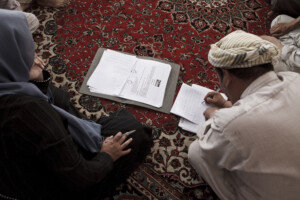
Picture credit: © Maeva Dubois pour Action contre la Faim