Swingeing budget cuts are undermining the humanitarian system. And humanitarian pooled funds are now (re)emerging as a solution to do more with less. But beyond money transfers, can these mechanisms deeply restructure a form of governance that has become too centralised and hierarchised?
Since the 1990s, the global system of humanitarian action has become ever more centralised due to the creation of the United Nations Office for the Coordination of Humanitarian Affairs (OCHA) and a concentration of decision-making power at the level of the United Nations (UN). Moreover, since 2020, 70% of humanitarian aid has come from only eight funders: the United States (US), Germany, the European Union (EU), the United Kingdom (UK), Sweden, Saudi Arabia, Japan and Norway.[1]Chen Reis and Maryam Z. Deloffre, “Defending humanitarian aid in terms of national security obscures its real purpose”, The Conversation, 21 March 2025, … Continue reading This concentration of decision-making power and resources in the hands of a small number of states, international organisations (IOs) and international non-governmental organisations (INGOs), to the exclusion of communities and local non-governmental organisations (LNGOs) and national non-governmental organisations (NNGOs), has created a system that is expensive, unequal and hierarchical. Furthermore, over the past decade, humanitarian needs have grown faster than funding has.[2]Chen Reis and Maryam Z. Deloffre, “Defending humanitarian aid…”, art. cit. This gap between players has aggravated the system’s difficulties in responding to humanitarian crises effectively.
“Humanitarian pooled funds (HPFs) are presented as one of the silver bullets that can improve effectiveness of aid, protect aid organisations from the political whims of state funders and honour commitments in localisation.”
Given today’s rapid changes in the aid world and the brutal, drastic cuts to foreign aid from big state funders, such as the US, of course, but also the UK and Germany, the humanitarian system, under the auspices of the UN, is considering a “humanitarian reset” to develop strategies to do more with less.[3]Tom Fletcher, “The humanitarian reset – Message from Emergency Relief Coordinator Tom Fletcher to the humanitarian community,” 10 March 2025, https://www.unocha.org/news/humanitarian-reset-0 For this “reboot”, humanitarian pooled funds (HPFs) are presented as one of the silver bullets that can improve effectiveness of aid, protect aid organisations from the political whims of state funders and honour commitments in localisation.[4]Tom Fletcher, “The humanitarian reset…”, op. cit. ; Déclaration commune en réponse à la proposition de refonte du système d’aide humanitaire, Refugees International et al., 10 April 2025, … Continue reading
An HPF, which is an aggregate of contributions from multiple funders in a single account, distributes its funds to humanitarian organisations. These funds are not reserved for a particular organisation or a predetermined project. There are many forms of HPFs, managed either by the UN or by non-governmental organisations (NGOs). Up to now, analyses of pooled funds have focused on the way in which they could improve the quality of funding and the effectiveness of aid resulting from it.[5]Christian Els, Country-based Pooled Funds: The NGO Perspective, Norwegian Refugee Council, November 2019, … Continue reading These solutions reflect a technical and operational mindset that seeks to repair and improve the current system.
Yet the matter has changed. The political, material conditions specific to the 1990s[6]Michael Barnett, “Humanitarianism transformed”, Perspectives on Politics, vol. 3, no. 4, December 2005, pp. 723–740. produced today’s humanitarian system by favouring professionalised, bureaucratised organisations. These organisations have been able to develop the capacities needed to draft complex subsidy requests, carry out audits and assessments and lead lobbying in Washington and Geneva. These characteristics are not inherent to humanitarian aid, but rather, they have been adjustments to this relational context. The early-2025 bombshell destabilised this system and modus operandi. Against this backdrop, I maintain that we should no longer view HPFs as simply channels for transferring money but as vehicles for interaction[7]Maryam Z. Deloffre and Sigrid Quack, A Relational Approach to NGOs in Global Politics: Beyond Cooperation and Competition, Oxford University Press, 2025. that truly transforms relations between humanitarian players. What relations do we want to forge to create a humanitarian system that is less centralised and less hierarchical? This article looks at HPFs as mechanisms that can help rethink the architecture of global cooperation for humanitarian action and can blunt the effects of today’s widespread cuts in funding.
What are humanitarian pooled funds?
There are several kinds of HPFs, but they all share certain traits. HPFs bring together funds from multiple funders to focus on a specified goal.[8]Manisha A. Thomas, Pooled Funds: The New Humanitarian Silver Bullet?, Norwegian Refugee Council, September 2022 ; Marzia Montemurro and Elise Baudot Queguiner, Pooled Funding at a Crossroads: A … Continue reading The funds contributed are put together, rather than allocated to a particular organisation, and an independent, collective allocation process within the HPF determines the recipients of the funding. In this way, the funders do not decide upon allocations on their own.
By prepositioning resources before a crisis occurs, HPFs can improve the quality of aid by providing funding that is foreseeable, quickly available and tailored to current needs. It takes around three months to pay out funds collected via traditional processes of calls for funds, but OCHA’s country-based pooled funds (CBPFs) pay out funds in only a few days.[9]Manisha A. Thomas, Pooled Funds: The New Humanitarian Silver Bullet?, op. cit. ; Sudan Humanitarian Fund (SHF), 2024 Annual Report, OCHA Sudan, January 2025. Similarly, requests for emergency funds in response to disasters, issued by the International Federation of Red Cross and Red Cresent Disaster Response Emergency Fund (IFRC-DREF) can be accepted within 24 hours and the funds paid out within just 72 hours.[10] IFRC-DERF, 2025 Annual Plan, The International Federation of Red Cross and Red Crescent Societies’ Disaster Response Emergency Fund, 28 July 2025, … Continue reading
The table below (see below) lists a few examples of HPFs and illustrates differences between them in their model of governance, fund allocation process and funder portfolio. OCHA manages two HPFs: the Central Emergency Relief Fund (CERF) and the CBPFs. These funds mainly depend on funding from UN member states, so they are subject to reductions in these states’ humanitarian aid budgets. For example, between 2006 and 2024, only five countries – the UK, Germany, the Netherlands, Sweden and Norway – represented 66% of funding for the CBPFs and the CERF.[11]OCHA, Pooled Funds Data Hub, 2006-2024, https://pfdata.unocha.org/?chart=contributionsByDonor
According to a study from the International Council of Voluntary Agencies (ICVA), there are currently 68 HPFs managed by NGOs such as the Norwegian Refugee Council, Action Against Hunger, and Care.[12]ICVA, Mapping NGO-led Pooled Funds, 13 June 2025, https://www.icvanetwork.org/resource/mapping-ngo-led-pooled-funds Except for the CERF, the IFRC-DREF and the Change Fund, which are managed globally, these funds are linked directly to a particular country, so they are better positioned to develop relations with that country’s LNGOs/NNGOs, to foresee and meet real needs, and to allocate funding amounts that local players can manage more easily. For example, the Change Fund, through NEAR (Network for Empowered Aid Response), and the Local Intermediary Actors Network (LIAN) in Myanmar are both governed by advisory boards made up of local and national players that assess funding requests and allocate funds. So, among all HPFs, they are the most localised ones, but they only fund their own members.
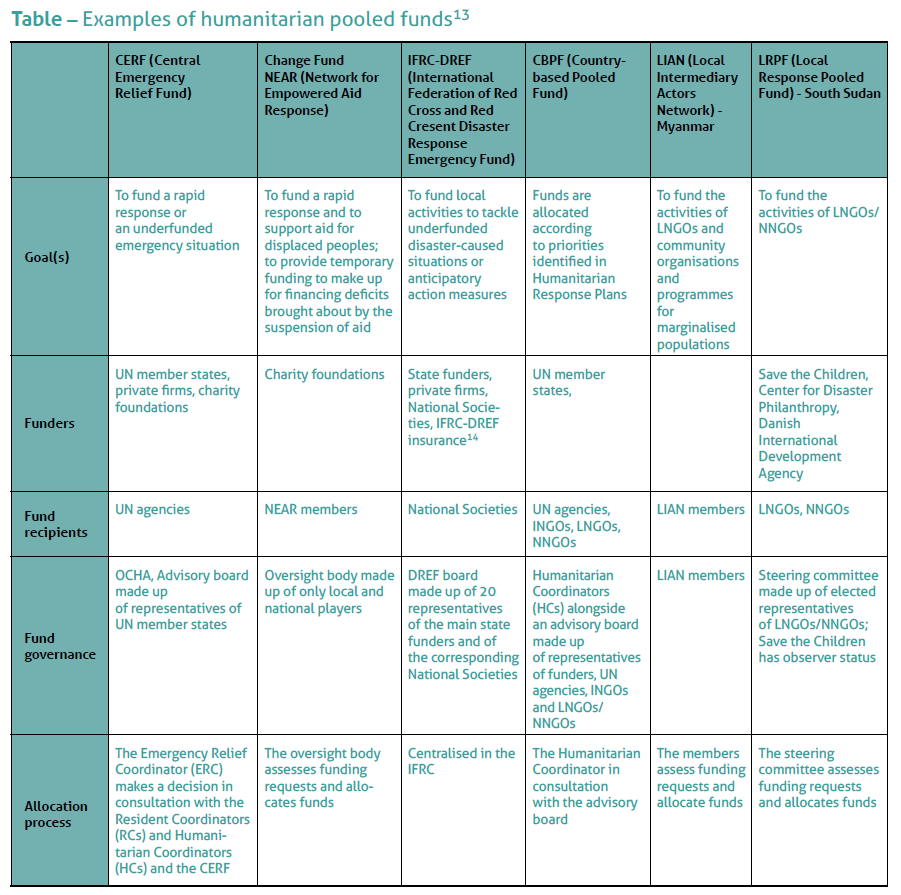
[13]OCHA, Central Emergency Response Fund FAQ, https://www.unocha.org/central-emergency-response-fund-cerf-faq ; United Nations CERF, The CERF Advisory Group, https://cerf.un.org/about-us/advisory-group … Continue reading[14]Voir : https://www.ifrc.org/fr/actualite/appels-durgence/fonds-durgence-pour-les-reponses-aux-catastrophes-dref/lassurance-du-dref
Despite their development, pooled funds only cover a small portion of humanitarian funding today. In 2024, total funding tracked by the Financial Tracking Service amounted to $24.95 billion, with contributions to the CERF amounting to $576.4 million (2% of the total) and contributions to the CBPFs amounting to $1 billion (4% of the total).[15]United Nations CBPF, Country-based Pooled Funds Data Hub, 2024, https://cbpf.data.unocha.org ; United Nations CERF, Central Emergency Response Fund Data Hub, 2024, https://cerf.data.unocha.org In 2024, the DREF allocated $107.4 million (0.4% of the total).[16]IFRC-DERF, 2025 Annual Plan, op. cit.
How can pooled funds help transform the architecture of humanitarian action?
In terms of standards, HPFs offer the potential to bring about a return to humanitarian principles. Indeed, since these funds are collective, the strategic and programmatic decisions about them are also collective. This collective decision-making can mitigate funders’ tendency to prioritise their own foreign policy goals (for example, “America First” or “The Netherlands First”). By strengthening standards and principles that are universally accepted, HPFs can also put an end to a crony approach to aid and improve accountability to the populations affected, especially because they include representatives of LNGOs/NNGOs on their advisory boards. Cooperation between funders can speed up harmonisation of requirements for reports and audits, improve transparency and bring down management costs.[17]Manisha A. Thomas, Pooled Funds: The New Humanitarian Silver Bullet?, op. cit.
The policy of localisation, proper implementation of which has struggled, requires funders to reduce their dependence on large IOs and INGOs, which are able to manage important contracts, and to increase their contracts with LNGOs/NNGOs, which are unable to handle huge sums of money. From a funder’s perspective, localisation increases their administrative burden and the financial risks of dealing with new partners. Given the recent budget cuts, this lack of administrative capacity will only get worse. Yet HPFs can reduce funders’ administrative burden by managing relatively small sums of money and by providing administrative support on the ground. Nevertheless, HPFs are intermediaries: by dealing with HPFs, funders can face extra handling fees.
Pooled funds can thus advance localisation by linking together local and global players, by working with national governments and by strengthening the capacities of national players.[18]Marzia Montemurro and Elise Baudot Queguiner, Pooled Funds at a Crossroads…, op. cit. ; Manisha A. Thomas, Pooled Funds: The New Humanitarian Silver Bullet?, op. cit. Indeed, the cooperation between INGOs and LNGOs/NNGOs that is promoted by pooled funds could help strengthen civil society, reduce competition between NGOs and develop new methods for aid.[19]Patrick Saez, Jeremy Konyndyk and Rose Worden, Financing the Humanitarian Public Good: Towards a More Effective Humanitarian Financing Model, Policy Paper 215, Center for Global Development, 7 July … Continue reading For example, in Myanmar – a state that has been in conflict for decades and where the military junta stops civil society from flourishing – the CBPF negotiates relations between funders, the UN, INGOs and LNGOs/NNGOs, both to channel funding towards community organisations and to bolster civil society.[20]Maryam Z. Deloffre, “Brokering localization…”, art. cit. Coalitions like the Joint Strategy Committee or the LIAN have long sat on the board of the CBPF for Myanmar, so they take part in the decision-making.[21]Maryam Z. Deloffre, “Brokering localization…”, art. cit. In conflict zones, intermediaries like the CBPFs and coalitions of LNGOs/NNGOs make fund allocation easier, collect and share information, and offer protection against authoritarian governments.
In Sudan, where civil society is active but informal and where coalitions of INGOs and of LNGOs/NNGOs are weak, the CBPF for Sudan has, since 2023, introduced several mechanisms for channelling more funding towards LNGOs/NNGOs, including the mutual assistance group. This flexible funding method was designed to fund community initiatives on a small scale with a 48-hour response time. Consortiums of NGOs receive funds in advance and are accredited to examine and fund simplified proposals from community groups to make quick responses possible, following methods that encourage partners to work together on the development of proposals.[22]Maryam Z. Deloffre, “Brokering localization…”, art. cit. ; Sudan Humanitarian Fund (SHF), Annual Report…op. cit. Once again, such methods reduce competition between INGOs and LNGOs/NNGOs, break down barriers to funding requests and strengthen local leadership. Furthermore, they have prompted a significant increase in direct and indirect funding of NGOs over the past two years.[23]Maryam Z. Deloffre, “Brokering localization…”, art. cit. ; Sudan Humanitarian Fund (SHF), 2024 Annual Report, op. cit.
Smaller scale, bigger reach
Before January 2025, many debates focused on the way pooled funds could help the system operate more quickly, more effectively and more fairly.[24]Christian Els, Country-based Pooled Funds…, op. cit. ; Dominik Koeppl, Country-based Pooled Funds…, op. cit. ; Andy Featherstone and Tasneem Mowjee, Desk review on enhancing the potential of … Continue reading Instead, I would like to suggest seeing pooled funds as intermediaries that could help restructure the system. We need to focus our attention on the type of relations we want to prioritise. In a recent analysis, I studied the CBPFs for Afghanistan, Myanmar, Sudan and the Democratic Republic of the Congo (DRC) to discover how they negotiate relations between funders and the UN and between INGOs and LNGOs/NNGOs[25]Maryam Z. Deloffre, “Brokering localization…”, art. cit..
This analysis revealed that although CBPFs are standardised in compliance with OCHA’s rules, they do not operate monolithically and the different models that I identified contribute to varied degrees of localisation. In any case, changes made to institutional rules, such as eligibility restrictions on NGO funding and requirements for LNGOs/NNGOs to be represented on advisory boards, have played a decisive role in improving localisation. For example, in the DRC, the number of partnerships between LNGOs/NNGOs and the CBPF has increased, as has funding for LNGOs/NNGOs, while funding and contracts for the UN have decreased over the same period.
By paying out smaller sums to a greater number of smaller organisations that do not have the same capacities, pooled funds can contribute to the diversification of humanitarian organisations. This diversification can spur innovation, trigger a restructuring of aid networks and boost representation of new ideas and new voices.[26]Maryam Z. Deloffre and Sigrid Quack, A Relational Approach to NGOs in Global Politics…, op. cit. The key is to understand how the different aspects of HPFs – their governance, eligibility criteria and decision-making – contribute to this restructuring. We have a few ideas about how HPFs can speed up decentralisation of the humanitarian system. But we need more research on the intermediaries – both international and local ones – to better understand which mechanisms in which contexts improve localisation and the quality and effectiveness of aid.[27]Alejandro Posada, Alice Obrecht, Courtenay Cabot Venton et al., Intermediary Models to Advance Locally Led Humanitarian Action, Briefing Paper, ALNAP/ODI, 25 February 2025, … Continue reading
Translated from the French by Thomas Young
Picture credit : FIN