Migration, severe poverty, unequal access to basic services, and health and climate crises are breaking down barriers between social action and humanitarian work in France, to the extent that international non-governmental organisations (NGOs) and social workers are increasingly rubbing shoulders in the country. This almost unprecedented convergence is being demanded by some and challenged by others. It is not only raising hopes, but also ethical, strategic and political issues.
Traditional frameworks are now teetering under the combined pressure of the migration, health and climate crises. On the one hand, practitioners in social work are facing increasingly extreme and long-lasting emergency situations and they have neither the resources nor training to manage these situations optimally. On the other hand, humanitarian non-governmental organisations (NGOs) that have traditionally tended to focus mostly on international work are now operating in France. Some, such as Médecins du Monde (MDM) and Médecins Sans Frontières (MSF), have actually been working in France for forty years. They are all motivated by the severity of needs and the disorganisation of public systems, sometimes caused by the inaction of political authorities. More than ever before, the boundaries between social work and humanitarian work are becoming blurred and unclear and are overlapping.
“More than ever before, the boundaries between social work and humanitarian work are becoming blurred and unclear and are overlapping.”
The sheer scale of this convergence is almost unprecedented and is opening up new prospects for cooperation: NGOs can provide local areas with their know-how in crisis preparedness and crisis management, which social players can then tailor to the French institutional context. However, this convergence is full of pitfalls too: does involvement of humanitarian organisations not run the risk of legitimising state withdrawal at the same time? And does their involvement not also impose a project-oriented and emergency-based culture to the detriment of long-term social action and even depoliticise community aid?
This opens up a completely new area of major political and ethical issues: what happens to social action when it is forced to draw inspiration from humanitarian approaches or willingly does so? And what happens to humanitarian work when it puts down long-lasting roots in a political arena with a state deemed functional, a crisis management system and a welfare system?
This article draws on two field studies conducted by the humanitarian think tank Groupe URD in 2020[1]Johanna Baché, Crise(s) et urgences en temps de COVID-19 : Quelle plus-value des acteurs humanitaires en France ?, Groupe URD, November 2021, … Continue reading and 2023[2]Florence Chatot et Thomas Albertini, La fabrique des solidarités à Briançon : mécanismes émergeants d’aide et d’entraide à la frontière franco-italienne, Groupe URD, mars 2025, … Continue reading in Paris and the French town of Briançon, and aims to study the convergence of the two sectors, not in the sense of a merger, but rather as a fertile breeding ground from which new ways of working may emerge. The issue is no longer just about rescuing people, but also about considering how to prepare together, by coordinating social work resources, community dynamics and humanitarian workers’ international experience in order to create a local form of social, environmental and political aid.
Paris: bringing a humanitarian slant to urban social work in a pandemic
Although regarded as a relatively recent issue for most humanitarian NGOs, emergency response work in France has been a core concern for social workers for several decades. The roots of emergency response work are to be found in the overlapping post-1973 crises (the energy crisis, labour crisis, the endemic housing crisis in big cities and so on), with social action undergoing “imposed change”, leading to a gradual transformation of practices: from long-term personalised support, there has been a gradual switch towards meeting ever-increasing basic needs, thereby exhausting social workers, who have been forced to water down their ambitions. Two key events signalled a shift in practices towards managing emergencies: the founding of Restos du Coeur (an association distributing food packages and hot meals) in 1985 and Samu social (an urban humanitarian emergency service) in 1993.[3]Xavier Emmanuelli, a pioneer of humanitarian aid and the founder of Samu social in France, passed away on 16 November 2025. He was the first person to introduce the concept of “social urgency” in … Continue reading These events marked the start of the ever-increasing and implicit delegation of the state’s responsibilities to third-sector organisations and, at the same time, the start of a debate that continues to this day: should organisations take action at the risk of condoning defective public policies and replacing the state? And should organisations risk contributing to the weakening of institutional social services, and even bringing them into competition with the third sector and humanitarian sector?
The year 2015 saw the beginning of the “migration crisis” and, above all, the resulting “hosting crisis”, and rekindled this debate, as well as the issue of blurring boundaries between social and humanitarian work. It speeded up the involvement, in France, of the majority of international NGOs that had not had national French operations until that point. A few years later, the Covid-19 pandemic cemented and extended their domestic involvement, bringing to light both the failures of the institutional response and the strength of community rallying.
At a time when third-sector organisations and community movements found themselves at the heart of health and social urgency, and, like the civil protection system and institutional social workers, were contending with multiple difficulties, with the ambiguity of Covid-19 guidelines and with a lack of resources, international NGOs swung into action to an unprecedented extent. For those already working on the ground, it was primarily a question of adapting their initiatives or reactivating their “France” emergency response units, some of which had been on standby since the 2015 crisis. Mobile teams were deployed to work with the homeless and migrants living on the streets, while previously unseen medical support work was rolled out in hospitals, sometimes for the first time in their history. For others, the health crisis was an opportunity to start work in France (such as Première Urgence Internationale) and even open up a long-term “France office” (for example, Solidarités International and Action Against Hunger). In any event, the crisis triggered shared strategic thinking about the legitimacy of humanitarian work “here” and about the stance to adopt on “national” and “local” associations, but also on the French state, and whether the focus should be on an operational response or political advocacy.
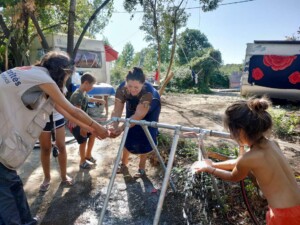
Several ideas took shape. While organisations such as MSF focused on emergency response work with the most vulnerable groups and political advocacy (acting and speaking out), others instead opted to support third-sector stakeholders and community organisations already operating on the ground. This was the case of Action Against Hunger in particular: the organisation based its work on a partnership-oriented approach, offering its expertise to players already in place (diagnoses, studies, training sessions for associations and community movements). Finally, for other organisations such as Solidarités International (historically involved in water and sanitation), their legitimacy was primarily based on providing technical expertise. Rather than pitting themselves against the institutions, they opted to help them by installing basic equipment (hygiene, water and infrastructure) in unconnected sites (migrant camps, shanty towns, etc.). In this case, the intention was to use practical initiatives to show the local authorities that proper management of such sites is not only feasible, but also effective for the local area.
Lastly, while humanitarian NGOs undoubtedly contributed, during Covid, to support for very marginalised groups and to coordination and advocacy efforts, their work triggered contrasting reactions in the third-sector and activist communities. Some stakeholders viewed the humanitarian intervention as a valuable and effective means of support, confirming the severity of the situation and legitimising the need for their involvement. However, others felt that, despite the NGOs’ best efforts, their involvement helped perpetuate a crisis modus operandi in France, thereby condoning state withdrawal and normalising situations that should not exist in this political context.
Briançon: socially focused hybridisation in a rural and border area
The town of Briançon, in France’s Hautes-Alpes department, has experienced a dynamic networking process since 2015, bringing together stakeholders who help welcome migrants crossing the Franco-Italian border.[4]For this topic, please refer to the article by Agnès Antoine, Ariane Junca, Guillaume Pegon et al., “The French Hautes-Alpes: community solidarity locks horns with a security ideology”, … Continue reading The area is home to a dense network of local associations (Refuges Solidaires, Tous Migrants, EKO!, groups roaming to help the homeless, etc.), social services (primary healthcare for people in precarious situations), accommodation and social reintegration services (emergency shelters), services for unaccompanied minors, and national organisations (MDM, Red Cross, Caritas France, Cimade, etc.), each delivering a link in the chain of welcoming: accommodation, healthcare, legal support and integration.
Humanitarian NGOs primarily provide financial, technical and advocacy support for locally created initiatives but do not replace them, with the local stakeholders feeling that it is vital to have a local foothold and independence. Following an initial phase of close cooperation with public institutions, the 2020 change of town council teams in France led to an almost complete breakdown, with associations taking over from a French state and town council both regarded as inadequate. Changes to migration policies (militarisation of the border, criminalisation of aid, unaccompanied minors being treated as adults, etc.) are today making it increasingly difficult to distinguish between “humanitarian” work and political struggle. Indeed, many third-sector stakeholders now accept that their work also constitutes criticism of public policies. Some tension has arisen between so-called “institutionalised” stakeholders (subject to legal frameworks, funding and management criteria) and activist cooperatives and community squats, which call for self-management, anti-institutionalism and a radically unconditional welcoming of migrants. The root causes of these conflicts are mainly the issue of unconditionality and the resulting prioritisation.
Here, as elsewhere, community cooperatives have been, and still are, the first responders due to the state being absent or inactive, coming up with, as a matter of urgency, forms of support, accommodation, outreach, legal support and digital activism (petitions, remote giving and support networks). By occupying empty buildings, organising squats and being comfortable with civil disobedience, some cooperatives are highlighting the issue of unoccupied housing, the violence of migration policies and the contradiction between legislation and fundamental rights. Local aid has to contend with administrative checks and crackdowns (procedures such as “facilitating unauthorised entry”) and is becoming an act of resistance when it is reported as a “crime”[5]The “crime of solidarity” is the term that was used to accuse several migration activists, and particularly Cédric Herrou, in the Roya Valley in France and Italy. His legal battle enabled him to … Continue reading by its detractors.
In this context, humanitarian NGOs provide support frameworks (healthcare, protection, support for unaccompanied minors, monitoring methods) that reduce some of the legal, health and ethical risks for both volunteers and migrants. By combining care with witness, organisations such as MDM and MSF help document rights violations, challenge authorities and public opinion and link local experiences to national and international issues. They offer financial and logistical support for hosting centres, provide equipment (tents at the railway station, for instance) and, in this way, join what Frédéric Meunier calls “a committed ecosystem that has proved its worth”[6]Frédéric Meunier, “The cause of exiles in France: the reticence of international humanitarian organisations called into question”, Humanitarian Alternatives, issue 18, November 2021, pp. … Continue reading by helping fund property purchases via foundations (specifically Fondation de France, Fonds RIACE France and Fondation pour le Logement des Défavorisés), which raise around €3 million annually, helping secure the long-term future of mechanisms that arise from community initiatives.
For the most part, this context demonstrates that these relationships are not just about cooperation or competition, but in fact make up an aid ecosystem underpinned by ongoing tension, in which each type of stakeholder – NGOs, community cooperatives and social players – contributes specific resources, yet also their own dividing lines, which are giving structure to aid and transforming it in the long term.
The dilemmas of coming together: caught between added value and distortion
The situations in Paris and Briançon demonstrate the added value that humanitarian NGOs can provide in certain crisis contexts. They show how these NGOs can support and significantly increase the capacity to respond to the urgent and unmet needs of the most vulnerable groups. They show how these organisations, apart from direct aid, can support a local third-sector and community fabric by providing targeted know-how: stakeholder coordination, volunteer operational capacity-building, making community cooperatives more professional, etc. They also showcase the role of mediator and advocacy partner that humanitarian organisations can take on. NGOs enjoy a certain amount of symbolic capital in terms of their “neutrality” and “respectability”, making them key partners for public authorities. So they are able to function as an interface, navigate between two often polarised worlds (grassroots activism and public administration) and, ultimately, convey the voice of frontline players to political decision-makers.
However, humanitarian workers’ undeniable contributions should not conceal what, for many, remains the most important and, ultimately, the most problematic issue: the sudden foray of NGOs into France’s national territory is, first and foremost, a symptom of state withdrawal from nevertheless crucial issues (migration, housing, access to food and healthcare). Consequently, by seeking to make up for institutional failings, there is a real risk of humanitarian NGOs worsening certain downward spirals, despite their best efforts. Indeed, how can they not play a part in eroding the model of social work mentioned above, while managing emergencies “effectively” and introducing new professional standards (indicators, a project-based approach, etc.)? A balance is doubtless achievable, but it is a delicate one. If they are “too” effective, NGOs run the risk of becoming the first-choice service providers for a state withdrawing from its sovereign remit. And perhaps some could gradually play a part in the depoliticisation of social and activist discourse.
Towards an ethics of commitment and complementary relationships
In the end, it is not a question of merging social action, humanitarian work and community initiatives, or artificially keeping them in silos, but rather of preserving and highlighting how their aid and protection initiatives targeting the most vulnerable are now converging. To achieve this, a critical and challenging dialogue needs to be held between these worlds. Indeed, it is the tensions themselves – about legitimacy, working methods, relationships with the state and political institutions and processes – that lead to more refined forms of action that are more tailored to local reality and are potentially more transformative.
In this respect, the French situation is holding up a mirror to debates on international aid “localisation”. Indeed, when humanitarian action is deployed “here”, in a context in which there is a state, public services and robust legal frameworks, they cannot ignore or stand in for them without running risks. In doing so, these experiences invite NGOs to reconsider, including in their “overseas” work, their stance with regard to institutions, local stakeholders and community dynamics, not just as simple “implementing partners” but also as fully fledged political representatives.
In the meantime, worrying signs are emerging: the combination of the effects of climate change, tougher migration policies and large-scale poverty – in the current context of the rise of the far right – heralds an increase in needs in France and an unfavourable political context, at the same time as the financial, human and activist resources of social stakeholders, and humanitarian organisations, are dwindling. This skewed situation fuels the risk of increased competition between spaces and organisations, sector-based withdrawal and political exploitation of aid by public authorities.
“The challenge is not only to coordinate responses more effectively, but to develop a shared resilience in response to systemic policies of exclusion.”
Consequently, the challenge is not only to coordinate responses more effectively, but to develop a shared resilience in response to systemic policies of exclusion. This involves acknowledging the intrinsically political dimension of aid, accepting alliances between social stakeholders, human rights organisations, humanitarian NGOs and community collectives, and together championing a vision of rights, dignity and hospitality that goes beyond simply managing emergencies. These new strategic convergences potentially mark the start of an innovative form of aid-resistance able to make up for the state’s shortcomings and get involved in legal issues to force the state to respect its legal obligations.
Today, the possibility of real local resilience may be playing out in this sphere: developing the capacity not to silently adapt but to use an everyday and organised model of living in harmony to counter dehumanising mindsets.
Translated from the French by Gillian Eaton