The operations of Solidarités International in France since 2020 reveal how access to water for vulnerable communities has led to a convergence of humanitarian action and social work. The non-governmental organisation, faced with on-the-ground realities in France, has, to some extent, hybridised its technical practices with strategies of community engagement and legal action, upending its traditional stance.
Are social and aid workers united in the same struggle? They are doubtless united if we mean, by this, a common fight against injustice. In both cases, their action is, in fact, driven by the same findings and by a shared outrage at the violation of fundamental rights and at basic human needs being expressed by those concerned yet unmet.
Aid work is generally understood as action aimed at meeting vital needs after a crisis or emergency threatening the survival and livelihoods of populations. It is expected to be deployed anywhere in the world, motivated by principles of humanity, neutrality and impartiality and regulated by international humanitarian law in the case of armed conflicts.
Social work, on the other hand, exists in a longer-term timeframe, within institutional and territorial frameworks, pursuing objectives of support and access to rights and basic services.
Guaranteeing this access is the responsibility of public authorities, the social worker having the vocation of bridging the gap between these authorities and the beneficiaries.
So, on the face of it, these two concepts and the fields they cover appear different. The theoretical differences lie in their relationship to time, their institutional frameworks for action and their sources of funding. The terms and methodologies of action, the career paths and training of the players involved lead to different stances in the face of social injustices in this world.
“This commonly-referred-to differentiation is less based on a fundamental disharmony than on the coexistence of two worlds, stemming from civil society, with distinct trajectories.”
Nevertheless, this commonly-referred-to differentiation is less based on a fundamental disharmony than on the coexistence of two worlds, stemming from civil society, with distinct trajectories. The spark that sets them in motion, however, is identical: outrage and a determination to act. In the end, their experiences, born of the same impulse but shaped by distinct spheres of action end up meeting, observing and sometimes shaking up each other, in particular when players from international aid action operate on French soil.
In the case of Solidarités International, this union enabled a coalition of common causes around rights to water, hygiene and sanitation (WHS) with new partners, as well as a hybridisation of practices and an impetus for new in-house courses of action.
The genesis of Solidarités International’s action in France
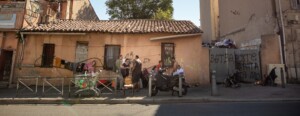
It all started with the Covid‑19 pandemic, which first hit France in February 2020. Its impact was particularly critical for vulnerable communities whose living conditions rapidly deteriorated, leading to an even greater undermining of equality of access to public services. Among the issues highlighted by the crisis, that of access to water and sanitation for homeless people and those living in makeshift housing (shanty towns, squats and camps) became abundantly clear. This access, limited as it often was before the pandemic, became almost impossible because of the health measures: restrictions on mobility linked to lockdowns, disruption of informal support networks and closure of public authority or non-profit organisation structures providing access to water, hygiene or sanitation.
Solidarités International was set up in 1980 to intervene in Afghanistan and usually operates in the context of conflicts or natural disasters all over the world, in particular in the field of WHS, and in combatting waterborne diseases, a major cause of mortality in the world. Apart from a few months working in the “Calais Jungle” in 2015, the organisation had never conducted long-term operations in France. The worldwide Covid-19 epidemic changed all that.
Because the disease called for protective measures based largely on hygiene – a core area of the association’s technical expertise – discussions rapidly took place within the non-governmental organisation (NGO) over whether it was appropriate for them to intervene. In March 2020 the decision was taken, backed by their emergency team, to launch a response aimed at providing assistance to people living in informal settlements and combining several technical and sanitary operations: installing drinking water supply points, installing and maintaining latrines, distributing hygiene and protection kits (masks, soap, etc.), along with measures to promote barrier gestures. Given the sheer scale of the needs and the inadequacies of the institutional response, Solidarités International decided to continue to be proactive in France in the fight against water insecurity. The organisation was particularly involved with those not connected to the drinking-water supply and notably with people living on the streets or in informal settlements and makeshift housing: shanty towns, squats, camps, etc.
The response from Solidarités International gradually built up in line with the pace of its integration in a French institutional[1]National players: the ministries in charge of health, the environment, social policies and their specialised agencies. Local players: regional and local authorities (municipal and intermunicipal … Continue reading and third-sector[2]Some examples of networks and associations: Coalition Eau, Romeurope, Notre Affaire à Tous, Astee (association specialised in water and sanitation technology) FNCCR (French National Federation of … Continue reading ecosystem it knew little about. This integration highlighted different professional approaches. A search for an appropriate stance among players providing aid to the most vulnerable led to a new professional rationale for both the association itself and its partners.
Discrepancy and convergence between technical and activist rationales
As experts in WHS, the NGO first proposed, in 2020, setting up a “cluster”, a term commonly used in the humanitarian field and which refers to a group of peers aiming to establish and define a common framework and a minimum baseline for action, accompanied by quantitative benchmarks, in this case suited to the French context. Although the establishment of a cooperative, today integrated in Coalition Eau[3]Movement of French NGOs committed to the human rights to water and sanitation and to water as a common good. (French water coalition), was welcomed, players already engaged in fighting for WHS in France had reservations about the proposal to fix standard thresholds or benchmarks.
Indeed, at first glance the idea of setting “minimalist” thresholds departed from the advocacy approach of players committed to social justice. Quantitative benchmarks, if not contextualised, presented the risk in the eyes of these partners of freezing standards at a minimum level, with the effect of creating a low threshold which could justify limited action rather than stimulate improvements. Their preference was for qualitative intervention guidelines which would make it possible to take into account the diversity of contexts and needs and would serve as leverage for tangible social progress.
From 2022, the transposition in France of the European Drinking Water Directive[4]Directive (EU) 2020/2184 of the European Parliament and of the Council of 16 December 2020 on the quality of water for human consumption (recast), Official Journal of the European Union, L 435/1, 23 … Continue reading (DWD) provided a shared framework facilitating the emergence of common ground and collaboration between the aid and social sectors with the opportunity to help clarify certain provisions central to the effectiveness of the right to water. The introduction into the French Public Health Code of a quantitative range of 50 to 100 litres per person per day, via the order[5]Ordonnance no 2022-1611 du 22 décembre 2022 relative à l’accès et à la qualité des eaux destinées à la consommation humaine, Journal officiel de la République française, no 0297, 23 … Continue reading transposing Article 16 of the DWD, was a first measurable benchmark, previously absent from French legislation.
In addition, in 2025, Coalition Eau established complementary indicators[6]For further information, see the Coalition Eau (In French), Comment évaluer le niveau d’accès à l’eau et à l’assainissement en France ?, note de positionnement, 16 juillet 2025, … Continue reading to better qualify the lack of access to water, whether in public spaces or in informal housing. These benchmarks rely on a human-rights-based approach, including key principles such as non-discrimination, access to information and participation of the people concerned. They also take into account the specific social and cultural circumstances of an area in order to adapt interventions to the local context and to come closer to truly effective action, respecting the right to water and sanitation. These indicators are the fruits of an encounter between actors with diverse backgrounds, combining humanitarian know-how and social and legal expertise, and who, together, have succeeded in building tools adapted to realities in the field.
Rethinking the participation and commitment of the people involved by mobilising communities
Interaction with partners in the social sector also enabled teams from Solidarités International’s France programme to understand the need to back up their purely technical skills in WHS with “social” expertise during these operations.
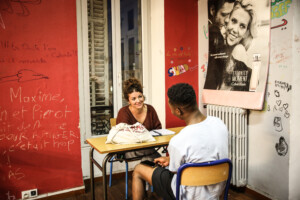
Though the community mobilisation component is one aspect of humanitarian action, it occupies a particularly important place in Solidarités International’s programmes in France, to the point of having become the cornerstone of its intervention strategy. The aim of the concept, inspired, moreover, by methods from the field of social work, is to empower communities when systems are absent or discriminatory. The use of vocabulary imported from the English-speaking social sphere and subsequently adopted by the humanitarian sector nevertheless made it necessary to clarify the concepts of “community” and “mobilisation” with French-speaking organisations on the ground, who had not always interpreted them unambiguously.
The term “community” should be understood in its most concrete sense as those things linking individuals sharing a space, common interests or objectives, as is the case of those living collectively in makeshift housing. As for the notion of “mobilisation”, it refers to the coordination of this group around shared interests, seeking solutions developed and implemented collectively.
“Community mobilisers” seek to respond to the needs expressed by populations by building collective solutions that empower them and are rooted in their lived reality rather than being designed for them. These objectives move towards reinstating people’s self-expression in a central role and restoring their status as rights-holders. The stance behind the response lies at the crossroads between several professions: that of the special-needs teacher, committed over a long timeframe and with active listening; that of the social worker, a reminder and guarantor of the rights to which people are entitled; and that of the facilitator, using methods of “community organising”.[7]Julien Talpin, « Quand le “community organizing” arrive en France », Revue Projet, no 363, avril 2018, p. 29-37, https://shs.cairn.info/revue-projet-2018-2-page-29?lang=fr And the common thread is the constant aim of ensuring the appropriation, implementation and maintenance of effective access to existing services.
Moving from a needs-based to a rights-based approach
As early as in September 2020, Solidarités International was questioning its vocation to maintain a long-term mission in France. Because of its history, its actions have, indeed, mainly been aimed at meeting the basic needs of populations in the short term. Yet data from the field showed that even beyond the Covid crisis, there was still a great need for access to water, hygiene and sanitation among people in substandard housing.[8]For further information see Coalition Eau (in French), « Les enjeux des données sur l’accès à l’eau et à l’assainissement en France », octobre 2025, … Continue reading The epidemic played a significant role in revealing these pre-existing needs and enabled the actors to demonstrate that intervention in the field of WHS was possible in France. In the context of systemic shortcomings, Solidarités International realised that continuing its programmes in France would mean depending on complex institutional flexibilities requiring technical and political expertise and an ability to negotiate with local and regional authorities and decentralised government departments. However, any room for manoeuvre was limited by the strict division of responsibilities between the fields of accommodation and housing, social welfare, and sanitation and drinking water, leading to the need for a significant presence in cooperation initiatives in order to coordinate schemes at the intersection of several sectors, with a clear focus on contributing to development or improvement of public policy.
From advocacy to legal action
In an attempt to overcome these political and institutional barriers, Solidarités International first engaged in actions of advocacy, enlisting local and regional authorities, decentralised government departments and national players to incorporate access to water and sanitation into an effective regulatory framework.[9]By working, for example, on the Universal Periodic Review – EPU 2023 (Coalition Eau, « Recommandations acceptées par la France », 20 octobre 2023, … Continue reading At the same time, the organisation gave technical support to the authorities in conducting diagnostic assessments of their local areas, helping identify vulnerable groups and putting forward appropriate measures, thereby consolidating the implementation of water-rights operations. However, this experience highlighted the limits of these initiatives: certain regulatory barriers and institutional deficiencies could not be overcome by political and technical mobilisation alone. So the organisation experimented with taking legal action, aiming to transform the rights proclaimed into concrete commitments and translate community-expressed needs into enforceable rights.
These actions were carried out with a new legal basis as a result of the transposition into French law of European Union (EU) Directive 2020/2184 and as part of a broader international framework recognising the human right to drinking water (United Nations resolution 64/292 in 2010). Solidarités International also uses this framework in the other areas in which it operates.
“The experience gained through its programmes in France led the organisation to rethink its traditional international position focused on responding to basic needs, in order to move towards a rights-based perspective.”
The experience gained through its programmes in France led the organisation to rethink its traditional international position focused on responding to basic needs, in order to move towards a rights-based perspective. Rather than merely compensating for material or sanitary shortcomings, the organisation has also begun to focus its interventions on the effective right to water and sanitation by identifying regulatory and political shortcomings and then resorting to legal action. The recourse to litigation was a new practice for the organisation, complementing and reinforcing its advocacy work: where advocacy aims to influence policies and raise awareness within authorities, legal proceedings make these requirements effective in law, translating proclaimed rights into legally binding obligations. This recourse, unusual in the aid context, was developed with input from social welfare associations, enabling humanitarian expertise to be combined with legal strategies in order to make rights to water and sanitation a reality.
Ultimately, Solidarités International’s experience in France shows that humanitarian action and social work, far from being mutually antagonistic, can come together and reinforce each other in confronting rights infringements and the unacceptable. By coordinating intervention in WHS, community mobilisation, advocacy and legal strategies, the organisation offers an integrated approach to combatting water insecurity in France. Its experience in its programmes in France has enabled – and will continue to enable – Solidarités International to improve its methods of operation in other contexts, just as the organisation’s humanitarian experience has enhanced social work.
Translated from the French by Fay Guerry
Picture credit: Solidarités International