

It has long been argued – and rather simplistically so – that the purpose of humanitarian action is to treat the physical ailments of populations in foreign countries affected by political crises (conflicts) or natural disasters, whereas social action aims to mitigate health, legal or economic shortcomings within the “domestic” space of a given country. Is this distinction relevant and, above all, is it consistent with reality and the ever-increasing needs of so-called developed countries? Just as development and peace joined forces with humanitarian aid to form the “Humanitarian-Development-Peace” nexus, would it be inconceivable to add social action to the mix? Would this be seen as an inappropriate blurring of boundaries or a much-needed broadening of the scope of solidarity? Would it be a pointless complication of aims, roles and funding channels, or a welcome pooling of skills and know-how at a time when humanitarian action, development and social issues are facing unprecedented challenges?
The answers to these questions largely depend on how the terms are defined. Rony Brauman defines humanitarian action as “that which aims, peacefully and without discrimination, to preserve life with respect for dignity, to restore man to his capacities of choice.”[1]Rony Brauman, “Humanitarian aid”, Crash, 1 May 1994, https://msf-crash.org/en/humanitarian-actors-and-practices/humanitarian-aid France’s legal code Code de l’action sociale et des familles (Code of social action and families) states that “social and medico-social action aims to promote, within an inter-ministerial framework, the autonomy and protection of individuals, social cohesion and the exercise of citizenship, and to prevent exclusion and correct its effects. It is based on a continuous assessment of the needs and expectations of members of all social groups, in particular people with disabilities and the elderly, vulnerable individuals and families in precarious situations or living in poverty, and on the provision of benefits in cash or in kind. It is implemented by the state, local authorities and their public institutions, social security bodies, associations and social and medico-social institutions….”.[2]Article L.116-1 of French Law No. 2002-2 of 2 January 2002 renewing social and medico-social action [editor’s translation].
What is striking about these two definitions is their apparent similarity. Two things must be pointed out immediately, both of which are undoubtedly signs of two distinct fields and ways of acting: firstly, social action is led by the state, “within an inter-ministerial framework” and delegated to various bodies, whilst humanitarian action – at least that undertaken by non-governmental organisations (NGOs) – is independent of the state; and, secondly, humanitarian action aims “simply” to restore an earlier stability disrupted by a crisis,[3]Rony Brauman, “Humanitarian aid”, art. cit.: “the objective of humanitarian assistance is not to transform a society, as is the case with other forms of international solidarity, but rather to … Continue reading whereas social action aims to guarantee the greatest possible equality between members of the same society. With regard to the second point in particular, this would be tantamount to forgetting that the “crisisification” of our societies[4]Clara Egger and Fernando Espada, “Understanding the crisis of humanitarian action in the age of climate change”, Humanitarian Alternatives, issue 28, March 2025, pp. 1–5, … Continue reading is a sign of the exacerbation and globalisation of threats against the most vulnerable, which undoubtedly justifies a “scaling up” of means to respond to them.
In fact, according to The Humanitarian Coalition, a Canadian organisation, for example, “a humanitarian emergency is an event or series of events that represents a critical threat to the health, safety, security or wellbeing of a community or other large group of people, usually over a wide area”.[5]The Humanitarian Coalition, “What is a Humanitarian Emergency?”, https://www.humanitariancoalition.ca/what-is-a-humanitarian-emergency? For social emergency professionals in Europe and France, this is a concept with multiple meanings and which refers to “the need to intervene immediately and provide a response when faced with an unforeseen situation that is deemed to be threatening and puts the living conditions of individuals and/or families at risk.”[6]Piu Brémond, Élisabeth Gérardin et Julia Ginestet, « En quoi l’urgence sociale interroge-t-elle les pratiques professionnelles ? », Empan, no 46, 2002, p. 129-135, … Continue reading This type of intervention requires an immediate response, proximity to the user and anonymity or, at the very least, aid that is provided on an unconditional basis.
The effects of both humanitarian and social crises means that the objectives of humanitarian and social action are tending to converge, even though they differ in their approach. This raises questions about the place of both types of action in France and elsewhere.
Although they have very different histories, there have always been links between the two. In June 1945, at the end of World War Two, the United Nations (UN) was founded in San Francisco. A few months later, the introduction of social security in France marked the French state’s long-term commitment to universal social protection. Social action evolved over the years with the decentralisation of state powers between 1980 and 2000, which involved the establishment of CCAS (municipal centres for social action) under the responsibility of local authorities, and then regional authorities (at French department level) in the fight against exclusion and poverty, and the provision of social assistance for children, the elderly, and people with disabilities. Since then, three main pillars have formed the basis of French social policies – insurance, assistance and solidarity – which variously implement the principles of solidarity, redistribution and reduction of inequality.[7]Wikiterritorial CNFPT (Centre national de la fonction publique territoriale), Données générales: les principes des politiques sociales en France, 2018.
On the humanitarian front, developments in France also have their own story to tell. Founded in the early 1970s and becoming truly operational in the 1980s, humanitarian NGOs established themselves abroad, on battlefields and sites of natural disasters, but they quickly turned their attention – albeit in a haphazard manner and often with trial and error – to their home countries. In 1986, in Paris, the NGO Médecins du Monde opened the first free healthcare centre for the most impoverished, with the intention of closing it within six months. The aim of this initiative was to alert the public authorities to the plight of populations living in precarious situations by providing them with medical assistance in order to secure unconditional access to healthcare for everyone. Forty years later, its so-called “Mission France” is still the association’s biggest project. In 1987, Médecins Sans Frontières (MSF) launched its first programme in France, developing healthcare activities for the most vulnerable. In 1996, it launched a project providing social services and legal support for foreigners and, in 2017, a hosting centre for unaccompanied minors in the town of Pantin and the La Linière camp in Grande-Synthe. Even though the association’s active involvement in France has not been without some debate within the NGO,[8]Read Michaël Neuman’s article, particularly his comments on the role of MSF’s France mission, which has been the subject of much internal debate at MSF: “Médecins Sans Frontières France: … Continue reading its actions in France continue in Paris, on the northern coast and in Marseille, for example, often on a voluntary basis. Many other NGOs, initially operating abroad, are actively working in the country on issues that are much more social in nature than strictly humanitarian. The French Red Cross – a special case as it is statutorily an “auxiliary to the public authorities” – addresses similar issues (access to healthcare, epidemics, disasters, gender-based violence, child protection, etc.) abroad, in mainland France and in its overseas territories, i.e. in a wide variety of intervention contexts. Finally, let us not forget how, in 2020, the Covid-19 pandemic led to the mobilisation of some of these humanitarian actors on French soil alongside social workers, particularly by providing expertise in the field of epidemics and biosecurity. Some of these actions, developed in response to this health emergency, continue to this day – an undeniable sign that the skills of humanitarian actors have found a context in which they undoubtedly have a role to play.
Although public policies generally helped reduce poverty in France up until 2002, we have been witnessing a sharp resurgence in poverty, precariousness and homelessness over the past twenty years or so. The figures published by French associations and UN agencies are unequivocal on that score.[9]Fondation pour le Logement des Défavorisés, Médecins du Monde, Collectif Les Morts de la Rue, Utopia 56, Fédération des acteurs de la Solidarité, Coordination Nationale Jeunes Exilé·es En … Continue reading
So, should we now strengthen a union between humanitarian and social actors? As countries such as France – and others – address issues arising at home or abroad, should their intervention methods be allowed to become more closely aligned, at least partially? It is clear that international humanitarian standards are increasingly applicable to so-called “rich” countries. Yet given that basic needs in France and Europe often overlap with those of more distant countries (housing, food security, access to water, hygiene and sanitation, physical and mental health, protection, etc.) and are constantly growing, social workers regularly find themselves powerless due to a lack of measures tailored to address these vital needs.
Appropriate responses are being developed at an international level by humanitarian NGOs. Some of them are already active in France, while other responses from other actors are based on humanitarian principles, norms and standards.
Crises often provide fertile ground for social innovation. In response to them, the search for solutions must move away from an ineffective and outdated model in order to create new forms of response and then institutionalise them. The current social crisis, which failing to meet the vital needs of an ever-increasing number of people, is therefore generating reactions and searches for solutions and systems to mitigate this problem.
In this sense, and contrary to the wishes of those involved (who would prefer a solution to exist without the need for their involvement), the actions undertaken are a response to a crisis which neither the state, the market, nor the “traditional” third sector is addressing. The framework put forward by the institutionalist approach[10]Jérôme Blanc et Marie Fare, « Les monnaies sociales en tant que dispositifs innovants : une évaluation », Innovations, no 38, 2012, p. 67-84, … Continue reading to social innovation (the importance of objectives, a local foothold, criticism of the dominant model, a partnership-based approach around a unifying project, and the emergence of innovative rules and forms) makes it possible to characterise actions that fall within the scope of social innovation.
At a time when the social sector is penniless in France and the humanitarian sector is under attack from all sides internationally, such a union has the potential to not only strengthen both these ecosystems, but also to highlight their richness. Such an approach is also part of a broader strategy – one which has been frequently discussed in recent months – to unite humanitarian NGOs, human rights NGOs, or even environmental NGOs so that they can bring their full weight to bear in the face of the major political and economic trends that are emerging. That said, it is true that other voices are calling for everyone to “stick to what they do best” in order to protect economic models that are already weak or preserve their own specific characteristics.
This issue of Humanitarian Alternatives questions the very relevance of such a union. In their introductory article, Johanna Baché and Véronique de Geoffroy, from the humanitarian think tank Groupe URD, rightly point out that social workers continue to be confronted with increasingly extreme long-term emergency situations, and often lack the means and training to manage them effectively. They point out that humanitarian NGOs have know-how in terms of crisis preparedness and management, the use of which can be justified by the severity of the needs, the disorganisation of public structures and, sometimes, a lack of political will. Yet they justifi ably analyse the various risks, particularly that of endorsing failing public policies and acting as a substitute for the state, imposing a sense of urgency to the detriment of a culture of sustainable social action and thereby contributing to the normalisation of situations that should not exist in this political context. Furthermore, they address the issue of political engagement in civic solidarity in order to defend “a shared vision of rights” and the future of humanitarian aid when it becomes permanently embedded in a political arena.
From the organisation Terre des Hommes, Maria Bray and Lourdes Carrasco Colom take a critical look, from the perspective of psychosocial and mental-health support initiatives, at the influences power systems have on the people affected, with particular regard to colonial and racial issues. They offer an interesting analysis of the problem through the lens of mental health and psychosocial support (MHPSS) as a space of convergence, a bridge between social work and humanitarian aid. They note that humanitarian MHPSS “incorporates equitable, transcultural, rights-based and recovery-oriented perspectives, facilitating the transition from short-term emergency response to long-term social reintegration, collective healing and recovery” that allow social action and emergency response to coexist, provided that ethical issues and a “decolonial” approach are developed.
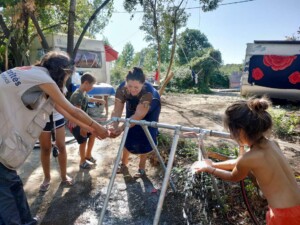
And what about “purely” humanitarian actors, if the term still has any meaning? Manon Gallego, Pauline Pruvost-Czapek and Brice Guillaume discuss the experience of Solidarités International in France, launched at the time of the Covid-19 pandemic. With hindsight, they show that, far from being antagonistic, humanitarian action and social work can come together and reinforce each other when they are driven by the same insight and indignation in the face of violations of fundamental rights and basic human needs that are not being met. They provide a clear analysis of the links with humanitarian criteria, minimum thresholds and the floor effect, as well as the link with the European directive on the quality of water intended for human consumption (Drinking Water Directive) and Coalition Eau (a French water coalition). Drawing on their experience, the three authors rightly address the issues of community participation and mobilisation, and the interpretations that this can generate.
From Action Against Hunger, Hélène Quéau, Arthur Maurus and Mathilde Fassolette analyse the actions and, above all, the stance of this NGO, before addressing a pre-existing social ecosystem with the specific objective of building synergy between practices in the humanitarian and social sectors. They therefore humbly question their relationship with public authorities and make the development of public policy a general objective. Action in the field, influence strategies, advocacy, political lobbying, and even legal actions are becoming the key levers needed to remind the state of its responsibilities. Given the needs and obstacles encountered, however, they question the relevance of a more operational commitment. The role of the people involved in empowering users, while avoiding token or exploited participation, is also rightly addressed.
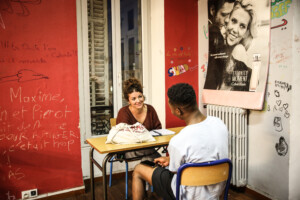
Véga Levaillant reports on the experience of MSF in the social sphere in France, through the opening of a day centre for unaccompanied minors. This programme has gradually integrated social work into its activities, no longer considering it solely as a means of gaining access to care but as a form of care in its own right. MSF’s journey opens up perspectives on how humanitarian and social approaches can interact, merge and enrich each other to address the needs of a young, isolated and deeply vulnerable population more effectively.
To conclude this edition, but certainly not the debate, Florian Hautevelle, Claire d’Hennezel and Frédéric Meunier describe a practical case of “humanitarian protection response” carried out by a coalition of civil society actors in the French city of Lyon. The link with local authorities, which provide support for the development of solutions that partly overcome an ineffective model, is described in detail. Relations with the social sector in general and common-law associations in particular and the place of the state are robustly addressed. This in vivo experiment provides an empirical answer to the question that permeates this edition: who, among players in social urgency or humanitarian action, can or should do what when a group of people is in danger? As an answer, the actions described here largely validate the hypothesis we had when we launched this edition: social and humanitarian actors still have much to discuss and achieve together.
Translated from the French by Derek Scoins