

A collective, coordinated, community response has been developed in reaction to a structural crisis affecting thousands of people in street situations in the Lyon Metropolitan Area in order to reduce exposure to risks and ensure that populations are safeguarded. This response draws inspiration from the humanitarian body of standards, which is used to legitimise an area of activity that falls under the state’s responsibility. It also gives access to rights and upholds them.
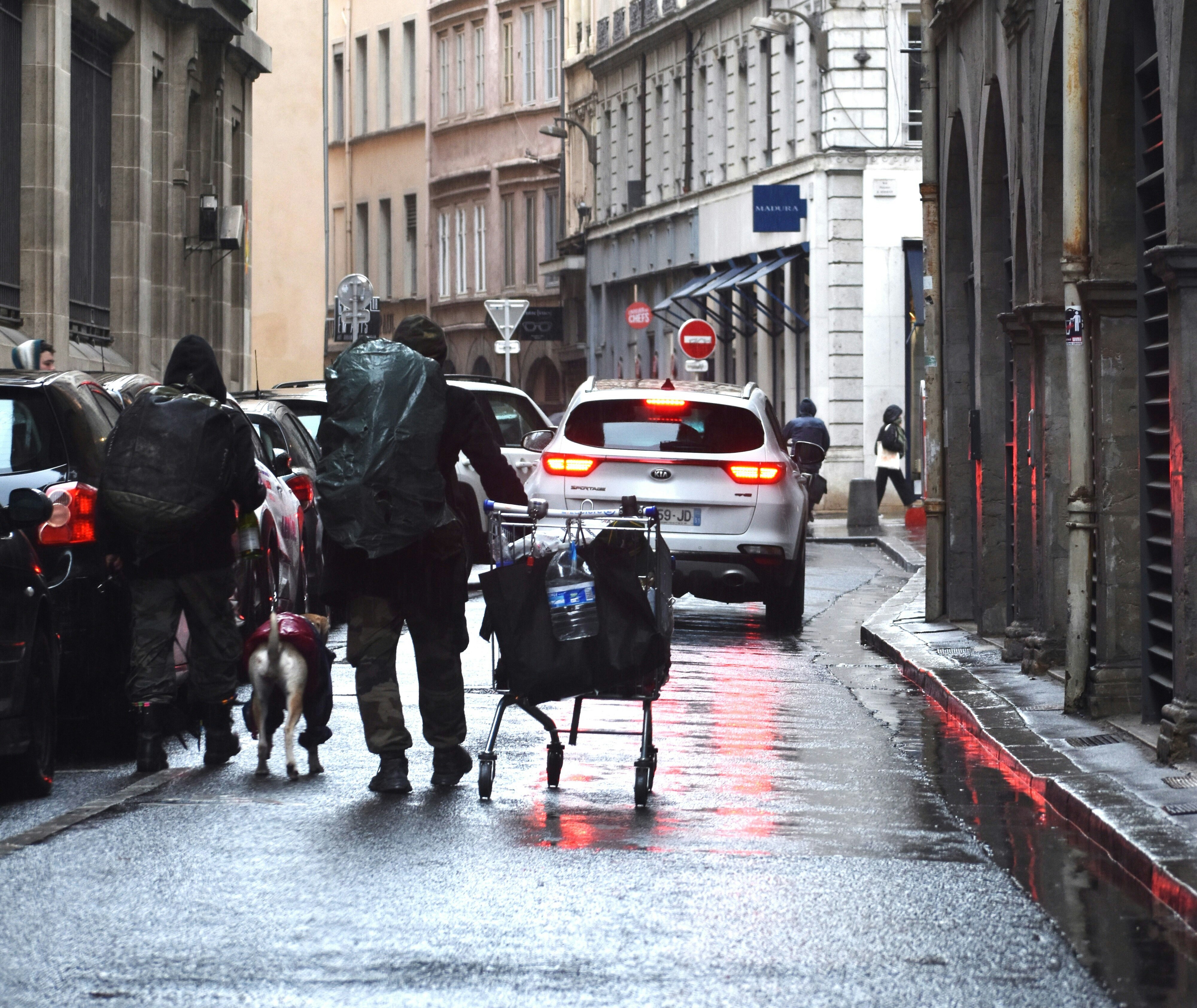
Year after year, the number of homeless people – or people “in street situations” in current parlance – is rising inexorably in France. The Lyon Metropolitan Area has not escaped this trend. There were 2,900 people, including around 500 children, in street situations in 2024.[1]Maison de la veille sociale du Rhône / Urbalyon, Le sans-domicilisme en 2024. Rapport annuel d’observation du sans-abrisme et de l’exclusion liée au logement dans la métropole de Lyon, … Continue reading A square located in the Croix-Rousse district has been the location of a makeshift camp since winter 2024. The camp is home to 280 unaccompanied minors who are seeking official recognition as minors.[2]An unaccompanied minor (UAM) is a child under the age of 18, of foreign nationality, who has arrived in France without an adult with parental responsibility or a legal representative. This person can … Continue reading Furthermore, 14,000 other people are homeless and on the housing waiting list. They are often in temporary accommodation, in a vulnerable situation, and on the brink of homelessness.[3]Alynea – Samu Social 69, « Alynea – Samu Social 69 maintient l’alerte sur la situation des 14 000 sans-domicile dans la métropole de Lyon et lance un appel à la solidarité citoyenne », … Continue reading
The same “temperature-based management” of temporary “cold weather plans”, which meet under 10% of the needs, takes place here as elsewhere in France winter after winter. Every summer, the hundreds of families housed in schools during the school year are thrown back out onto the streets. The numbers of tents on the pavements, in squares and in parks are increasing. The most sheltered nooks and crannies in our cities, squats and shanty towns become informal, long-term and dangerous living spaces for tens of thousands of people. This social reality causes repeated tragedies. Indeed, twenty-five people died due to homelessness in 2024 in the Lyon Metropolitan Area,[4]The collective Les Morts de la rue (Street deaths): deaths of homeless people in 2024, list compiled using reports (in French), https://mortsdelarue.org/listes and a fire in a cellar being used by squatters claimed four victims in October 2025. Living on the streets kills and physically and mentally destroys people. It exposes them to physical and institutional violence, with women and children being the most vulnerable sub-groups of the homeless population.
The so-called “social urgency” institutional responses do not or no longer manage to reduce or limit this crisis in any lasting sense. In response to the inadequate measures, undersized responses and the state’s detrimental political and economic policies, common-law local associations,[5]Third-sector organisations providing access to common-law social benefits (social assistance, accommodation, housing, healthcare, food, financial assistance, etc.). which are state service providers that implement social policy, are struggling to meet the level of need.
However, in the case of the Lyon Metropolitan Area, by way of compensation the area benefits from a high level of community involvement in a historically socially-conscious ecosystem. In 2022, 1,254 people were hosted in the community networks run by 1,630 volunteers.[6]. Nadine Camp, Visibiliser l’hospitalité : la place de l’hébergement citoyen dans l’accueil des personnes migrantes, Synergie Migrations, novembre 2023, … Continue reading The most active community hosting network, Aclaam, houses over 500 people at all times. The area has many community organisations and activist collectives. They endeavour to find solutions, including occupying premises in order to provide accommodation. Lyon has a vibrant history of squats, which points to its local activism, which was previously dynamic but is now tending to fade.
Nevertheless, the 2020 elections in Lyon and Villeurbanne and in the Lyon Metropolitan Area, saw the election of councils supportive of proactive policies on homelessness. These councils go above and beyond their mandatory responsibilities and remits and are in regular contact with community associations and collectives.
The emergence of a response
Confronted with this lasting and structural crisis without an institutional or political solution commensurate with the issues facing people in street situations in the Lyon Metropolitan Area, a grouping of local councillors and associations devised a collective and coordinated initiative in early 2024. The initiative is very similar in format to the “camp-based” emergency humanitarian approach, drawing on the experiences in the Calais region and Grande-Synthe.
A collective of homeless women occupied a cultural centre in Villeurbanne over the same period. The council supported the group, which was backed by associations and foundations,[7]Fonds RIACE France, Fondation pour le logement, L’Entreprise des Possibles and Fondation de France. in order to expedite the accreditation of a building, owned by the Vinci group, as accommodation. The project is going to be used as a basis for discussion and work in order to design the initiative, a hybrid of social innovation and humanitarian urgency.
The initiative is designed as a community response to a crisis and not as a public policy and must be large enough to have a real impact on people and move beyond “trial runs” so as to have a proper effect on the area. A target figure of around 600 people is considered to be appropriate. The response also needs to be multi-stakeholder and multi-sector and must aim to achieve lasting risk reduction for beneficiaries by safeguarding them in decent accommodation. The constraints involved in creating a “camp” are swiftly making way for a search for vacant office premises or housing, which must be occupied using agreements signed by associations.
The development of a coalition
In late 2024, a memo was drafted by the associations, councillors and the cabinets of the three councils. It endorses the observation that “the mechanisms and framework of social work, based on the ethos of combatting poverty and exclusion, are designed to be able to start the process of integration and access to housing, beginning with accommodation, and are no longer an appropriate way of meeting the need for emergency protection of groups in street situations.” This memo also highlights the fact that the current mechanisms do not meet the level of need, and only partially deliver what is needed in terms of a response to an immediate danger. The document also comments that “despite the involvement of the councils, to the very limits of their remits, local activists and collectives are increasingly lobbying their local councillors, accusing them of not doing enough on this issue.” In fact, as previously mentioned, the local councillors dealing with citizens are already shouldering responsibilities that are outside of their remits.
Moreover, the memo utilises a definition of international humanitarian urgency and specifies that the responses delivered require the implementation of specific resources (including budgets, stakeholders, equipment and buildings), going beyond what is done by traditional social work, in order to prevent a disaster or, at least, reduce its impact. Finally, it makes a call to develop a new local, more collective and efficient approach in order to meet the protection needs of groups in street situations. The memo was submitted to the three councils in December 2024 and they gave their agreement to move forward on this basis.
“The appropriateness of a response based on a humanitarian approach, alongside a social approach, was endorsed, provided that it does not negatively impact common-law provision of shelter.”
In early 2025, following an extensive consultation, specifically with international non-governmental organisations (NGOs) (Triangle Génération Humanitaire, Humanity & Inclusion and Médecins du Monde) and logistics and training providers (Bioport and Bioforce), the appropriateness of a response based on a humanitarian approach, alongside a social approach, was endorsed, provided that it does not negatively impact common-law provision of shelter (public social mechanisms, such as emergency shelters) by creating a “low-threshold” mechanism, and that it is separated from the field of social policy, in other words, that it does not compete with the existing and already insufficient resources.
A coalition was therefore formed, based on the commitment of a broad grouping of local stakeholders. It includes contributions from homeless collectives and local councils, while also including community hosting associations, activist associations, common-law associations, international NGOs and business (a consulting firm to assist the contracting entity with site regulatory compliance, tradespeople and small businesses for the building work, etc.).
Founding principles
The principles underpinning the humanitarian protection response were defined by fifteen collectives and associations running the operational dimension of the initiative. These principles were discussed with the three councils, were agreed by consensus and reaffirm the central role of the beneficiaries and compliance with international humanitarian standards and norms.
Serving as the common basis for the stakeholders during implementation, these principles create a space for intervention by positioning the response outside the scope of social work. They also enable a complementary and resolutely humanitarian approach, prior to social urgency mechanisms, enabling households in street situations to be safeguarded and stabilised before being supported by the standard social mechanisms.
The stakeholders behind the response, gathered together within a coordinating body, are putting in place bespoke governance mechanisms with several consultation and decision-making levels. Decisions and strategic directions are taken during inter-organisation meetings, to which the fifteen operational stakeholders (including two collectives of people concerned) are invited.
International humanitarian standards (Sphere) and the Core Humanitarian Standard on Quality and Accountability (CHS) are the benchmarks for the response. It guarantees that beneficiaries are involved in the initiatives and decisions affecting them, and informs them about resource management, the budgets allocated and their origins. The response also makes provision for a decent, furnished living space of a minimum of 5m² per person. Finally, active monitoring and alert management strengthen protection against human trafficking, coercive control and illegal activities. At the same time, rules governing housing and buildings open to the public are applied with the support of a private-sector consulting firm.
The humanitarian protection response
The stakeholders behind the response have identified several aims that should help reduce homeless people’s exposure to risk and enhance their integration process. They still need to finalise the implementation of a coordinated and joint framework of action. They urgently need to “get hold” of property and bring it into line with humanitarian and French standards in order to provide decent accommodation and living conditions. Phase two involves the drafting of guidelines on referring beneficiaries to common-law mechanisms, access to work and obtaining legal status. This will be undertaken at the same time as compensatory remedies, both on the basis of the right of residence and the French Social Action and Family Code, which makes provision for non-conditionality and continuity of accommodation.
In May 2025, the property search was aiming to house 200 people from two collectives of inhabitants of two squats, one of which had been evacuated in late 2024 following a fire that claimed the life of a young girl. The main challenge is convincing property owners to enter into agreements against a backdrop of a major property shortage. The Lyon Metropolitan Area’s engagement with social housing landlords is therefore pivotal in fostering trust and consequently find housing. Moreover, in order to fit out the properties, the local authority has made a 750m² warehouse available in the heart of Villeurbanne. This community warehouse opened in early 2025.
Over fifty accommodation units have been identified across nine sites and are managed by five associations that have signed temporary occupancy agreements. Some sites do not require any work, while others are highly dilapidated. Refurbishment of the most dilapidated premises is undertaken in record time because of high levels of volunteer and partner business involvement and the systematic participation of the beneficiaries. By June 2025, 131 accommodation places were available and over 210 people had been housed by early October.
The costs are shared by all the associations that sign agreements via a “communal fund” financed by jointly requested funding and managed by one of the associations. Allocation formulae are used to distribute the funds by expenditure type and by site (building work, charges, fixtures and fittings, etc). The first start-up funding was provided by the Fonds RIACE France endowment fund and covered some of the 2025 expenses, while other funding (mostly private) and a multi-year commitment from the Fondation de France will complete the funding plan. As of early 2026, six months after the start of the response, over 300 people have been safeguarded.
Providing access to rights and helping safeguard them
Leaving squats and moving into accommodation means that people can once again start getting access to rights. When formerly homeless people are stabilised in their “own place”, they can finally make use of common law to access their rights, starting by obtaining legal residence.
Moreover, under the French Social Action and Family Code, people are entitled to conditional accommodation. However, people can remain unhoused due to a lack of free places. This response constitutes an alternative to the streets. The humanitarian standard helps define the minimum quality requirement for accommodation under contract and refurbished by these new residents.
Agreement with common-law partners is vital to avoid subsequently limiting residents’ rights. The humanitarian response should enable social work to then take over. This is illustrated in the search for the right status to protect the subsequent phases with regard to access to rights. Indeed, being accommodated by a third party could mean that any housing applications made are deemed non-priority, given the procedures governing the service intégré d’accueil et d’orientation (SIAO – homeless housing and referral service),[8]The service intégré d’accueil et d’orientation (SIAO – homeless housing and referral service) is an umbrella organisation linking up the support, accommodation, integration and … Continue reading and could be detrimental to any appeals made under the droit au logement opposable (DALO – enforceable right to housing).[9]The droit au logement opposable (DALO – enforceable right to housing) enables social housing applicants to get their application classed as a priority in some specific circumstances, and … Continue reading Humanitarian action should not therefore be a lower-quality solution or a last resort: this is where the alliance with social work proves its worth.
Empowerment – everyone needs to take ownership of the situation
By placing empowerment at the heart of the mechanism,[10]To gain an understanding of the meaning and history of this term, whose French translation remains as elusive as ever, see for example: Marie-Hélène Bacqué et Carole Biewener, « L’empowerment, … Continue reading the implemented response enables each and every stakeholder to take responsibility for addressing the problem: getting off the streets, self-help, taking part in decision-making about the site and support provided, collective actions to obtain legal residence, and making use of the built environment. In this case, empowerment refers to both the residents and community associations, who are re-engaged in this initiative, but also the local councils, who draw inspiration from the humanitarian standard to act on their own initiative in a field falling within the state’s remit, social workers, of course, and the Maison de la veille sociale (the SIAO provider in the area).[11]The Maison de la veille sociale is the SIAO provider in France’s Rhône department (see above). Each stakeholder’s working practices can therefore be reinvented and they can even allow themselves to work beyond their usual remit in order to solve individual and structural difficulties. In opening up a pathway, the response creates new conditions for everyone to take ownership of the situation at their own particular level.
Creating public policy inspired by the humanitarian sector
Since 2011, French public policy on homelessness has targeted housing: this is the “Housing First” concept.[12]The five-year Plan for Housing First and Combatting Homelessness, known as the plan Logement d’abord (“Housing First Plan”), aims to quickly move homeless people from temporary accommodation to … Continue reading However, people without legal residence cannot exercise this right, meaning that they are not eligible for social housing or recourse to an enforceable right to housing (DALO).
This blind spot makes public policy partially ineffective. Without their administrative status changing, these people clog up emergency accommodation. This makes it impossible to meet all the needs. For people who have not been housed, there remains the option of an enforceable right to accommodation (DAHO – droit à l’hébergement opposable) appeal,[13]The DAHO (droit à l’hébergement opposable – enforceable right to accommodation) enables anyone in need or in a vulnerable situation to request accommodation suited to their needs. Relationship … Continue reading although living on the streets makes such an appeal physically difficult. In other words, the very poor regularisation policy is making the housing crisis worse.
“This initiative in Lyon does not create rights, but it can provide access to rights by addressing a public policy gap.”
The humanitarian response combines immediate shelter with medium-term work on regularisation and integration, with the support of local councils, and in conjunction with common law. This initiative in Lyon does not create rights, but it can provide access to rights by addressing a public policy gap. By breaking the “Housing First” policy deadlock, it also opens up a path to a solution that could, ultimately, help implement a “Housing for All” priority.
Translated from the French by Gillian Eaton
Picture credit : Daniele La Rosa Messina